

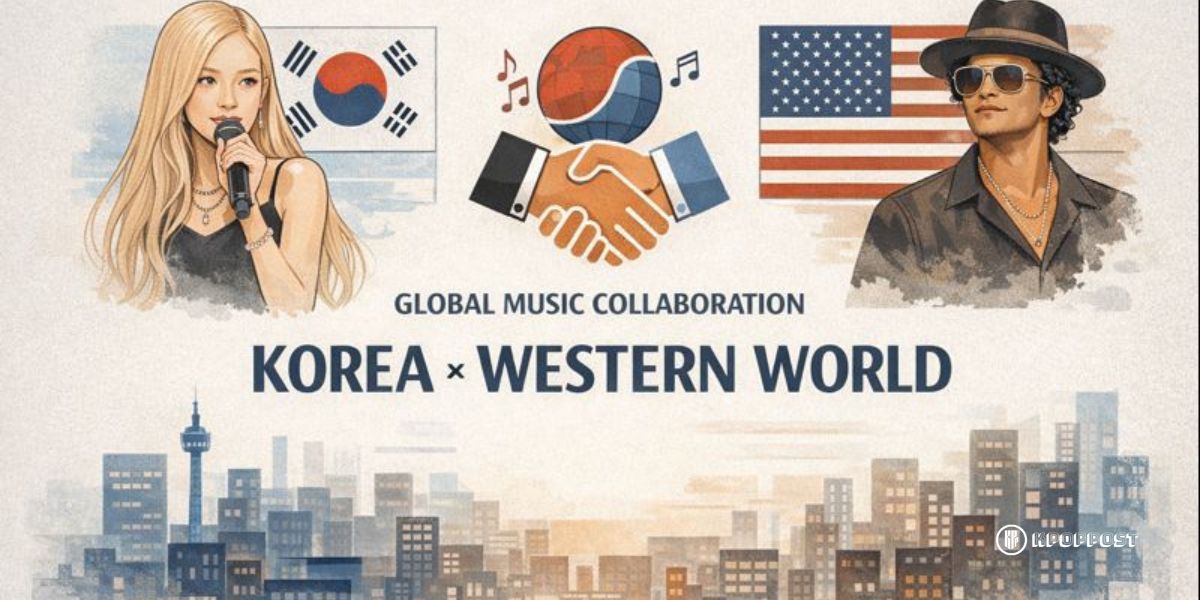
When the Grammy Awards unveiled its nominations on November 7, Rosé (Blackpink) and Bruno Mars’ collaboration “APT.” hit the ground running, earning three nominations, including Best Duo/Group Performance, Record of the Year, and Song of the Year. What began as a collaborative project, originating from a Korean table game concept, became a chart-dominating global release, steadily making its way into the Western Entertainment mainstream. This track went on to dominate the Billboard Global 200 for 12 consecutive weeks, reached the Top 5 of the Billboard Hot 100, and became Apple Music’s most-streamed song worldwide in 2025–underscoring not just commercial success, but a deeper level of cultural recognition within the Western music industry.
Today, Korean entertainment’s Western presence is slowly entering a transitional moment, moving beyond the “Breakthrough Era” and into a phase of structural integration within the Western industry through K-pop collaborations.
What Is Cross-Cultural Collaboration & Why Korean Entertainment Is Into It
“Cross-cultural collaboration” was never unfamiliar, especially within the Asian entertainment industry, dating back to the late 1990s and early 2000s. Partnerships between Asian artists have always functioned as a promotional and creative buzz, often appearing as expected entries on PR and release calendars.



Appearances in television dramas and other media became a creative excitement for cross-cultural content. Korean artists, such as Rain and Yoona, began appearing in Chinese television series, including “Diamond Lover” (2015) and “God of War, Zhao Yun” (2016). During that period of time, Korea was expanding through Hallyu–a movement in Korean popular culture that gained widespread popularity across Asia. Rather than relying completely on domestic exports, Korean entertainment placed its talents in foreign industries as a strategic approach. Collaboration has expanded influence and scaled Korean entertainment beyond its existing markets.
Why Korean and Western Collaboration Was Inevitable
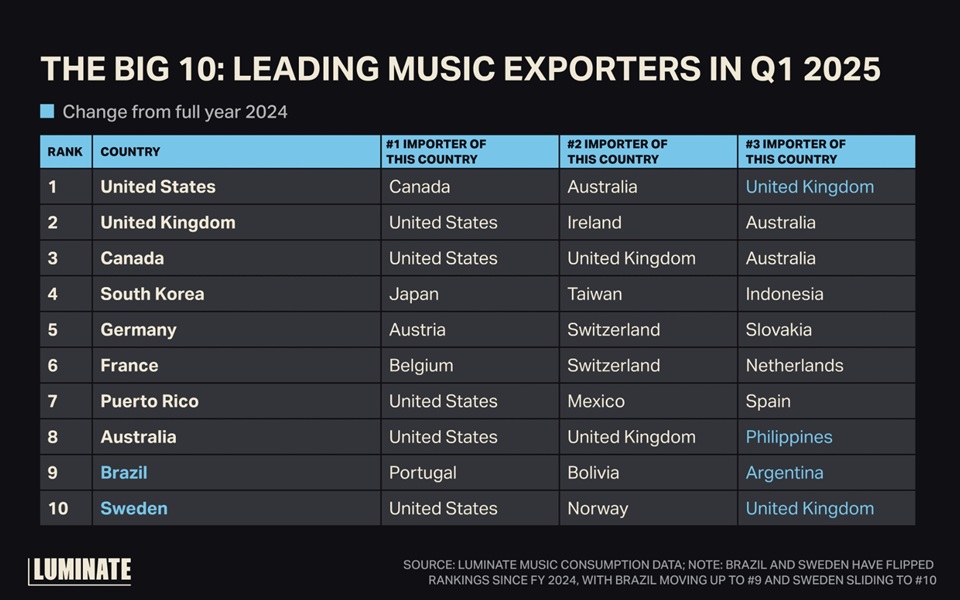
K-pop’s global expansion is undeniable at this point. South Korea consistently ranks among the world’s top music export markets, generating billions annually. While export strength confirms global demand, long-term influence in the music industry is still mainly controlled by the Western infrastructure. Collaboration offers a way to reduce risk for international individual artists by converting shared successes into industry-level recognition.
In this context, Korean and Western partnerships have become an inevitable strategy for sustaining long-term influence, with favorable numbers and performance advantages. This new raceway will become a trend in leveraging cross-cultural expansion.
Cross-Cultural Collaboration in Market Growth
Nowadays, Korean and Western artists operate as peer-level creative alliances, with the growing confidence in shared authorship and cultural influence. This mirrors broader industry trends, where collaborative releases consistently outperform solo international entries in longevity. One study found that collaborations can achieve an average 5 percent increase in total stream counts and about 13 percent uplift in first-week activity.
From a business perspective, this performance advantage helps explain why collaboration has become a preferred growth model. By activating multiple countries’ audiences and industry channels together, cross-cultural collaborations are better positioned to maintain momentum after initial debut and attract broader, multi-market attention than standard collaborations.
Statistic Comparison: “On the Ground” and “APT.”
The following comparison examines the Billboard charts between Rosé’s solo lead track, “On the Ground” from her 2021 album “R”, and her collaboration with Bruno Mars, “APT.” from 2025:
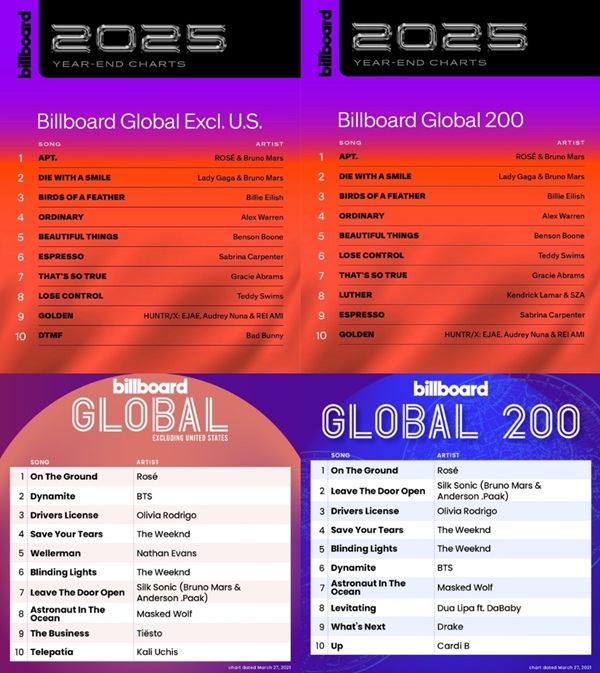
Rosé’s solo debut marked an important first step into the Western markets, but her performance with Bruno Mars shows just how collaboration can amplify reach and impact. As Rosé debuted, “On the Ground” shot its way up to Billboard Hot 100, settling at No. 70 and Billboard 200 at No. 1–an already impressive achievement for a K-pop soloist navigating the U.S. mainstream chart as an individual artist.
By contrast, “APT.” reached a higher level of integration. The collaboration broke into multiple major U.S. mainstream charts and topped them, maintaining a strong position while gaining recognition at the 68th Annual Grammy Awards. These outcomes again demonstrate the power of cross-cultural collaboration to deliver benefits and gain clear acceptance in Western culture as a foreign artist. And because of the vast success that Rosé and Bruno Mars achieved this year, this model signals a sustainable direction–one that will most definitely not be the end.
The New Movement: Western Expansion
Cross-cultural collaboration has become the engine to fuel one of the next phases of Korean entertainment’s global strategy–reshaping how the industry transitions from small successes to larger successes. Korean entertainment will continue to embed itself in the Western industry, using this technique to create buzz and excitement, drawing more eyes and audiences to their artists.
The success of cross-cultural projects will determine whether Korean entertainment can convert global popularity into long-term industry presence and expansion. If recent collaborations are any indication, integration will define K-pop’s future in the Western market.
Join us on Kpoppost’s Instagram, Threads, Facebook, X, Telegram channel, WhatsApp Channel and Discord server for discussions. And follow Kpoppost’s Google News for more Korean entertainment news and updates.