

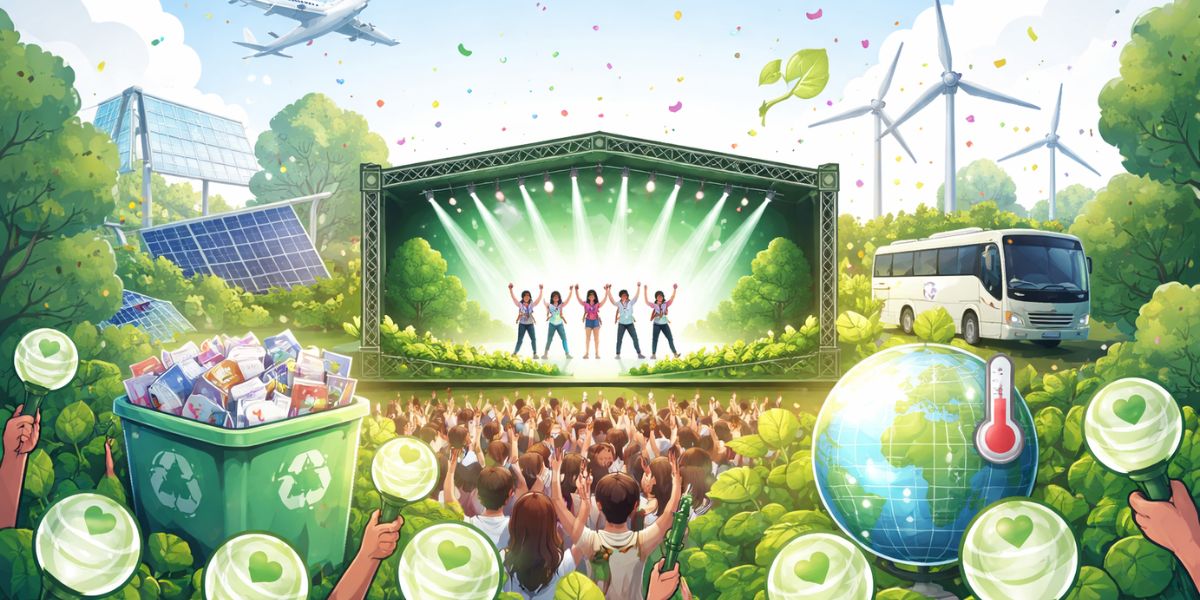
K-pop has built a global empire on loyalty, scale, and repeat sales. Now, that same loyalty is demanding climate accountability. A growing movement led by KPOP4PLANET is pushing for structural change. “Kpop Carbon Hunters” demand low-carbon concerts. 92% of K-pop fans demand change. This isn’t just about “save the trees” idealism. It is a business risk conversation. Will the K-pop industry change?
The Hidden Business Angle: 18 Years of Regulatory Stagnation
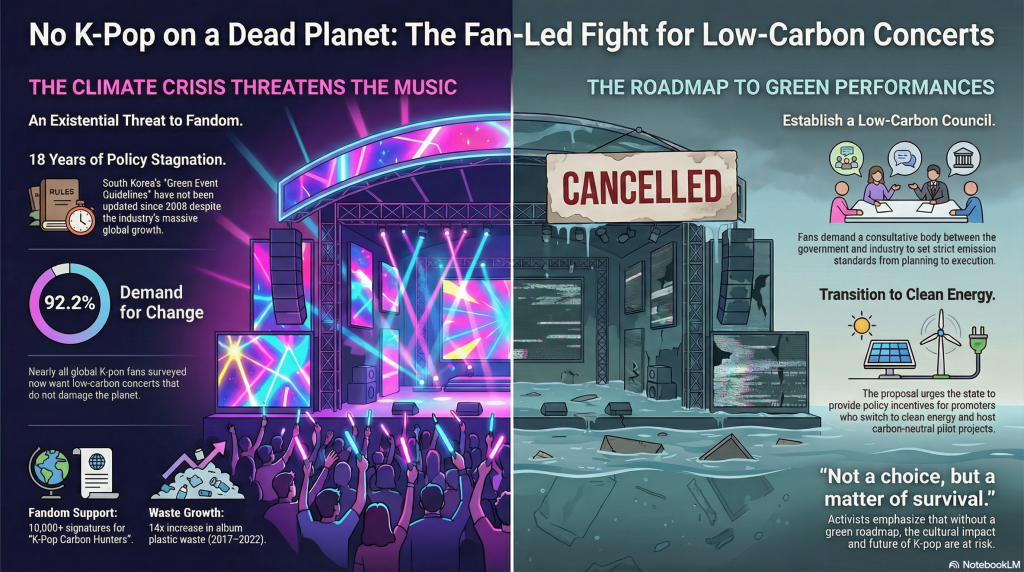
While K-pop grew from a local phenomenon into a global industry, environmental rules lagged behind.
South Korea’s “Guidelines for Eco-Friendly Low-Carbon Events” have remained largely unchanged since 2008.
For nearly two decades, the industry expanded without meaningful regulation.
This gap allowed high-volume marketing strategies to thrive—often at the environment’s expense.
The Hidden Cost of High-Volume Sales
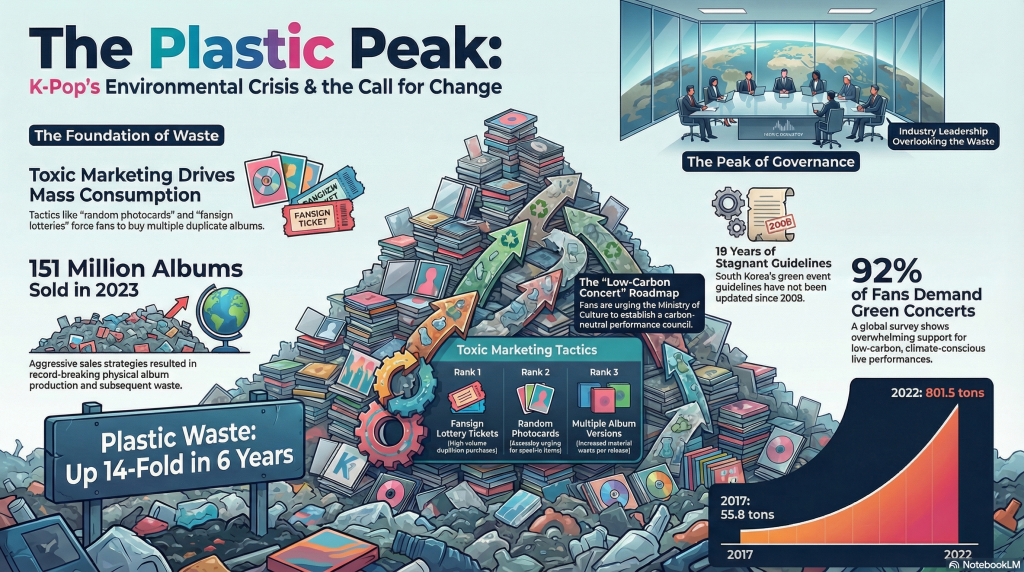
K-pop’s revenue model relies heavily on physical album sales. Multiple versions and collectibles drive repeat purchases.
Major agencies, including HYBE, have aggressively scaled this model. Two key tactics dominate:
- Fansign lotteries: Fans buy multiple albums to increase their chances of meeting.
- Random photocards: Dozens of collectible versions encourage bulk buying.
This strategy boosts short-term revenue. However, it increases plastic production and waste. Industry data shows plastic waste rising from 55.8 tons in 2017 to 81.5 tons in 2022.
That represents a sharp multi-year increase. Environmental cost is becoming a reputational liability.
From Global Growth to Climate Pressure
K-pop expanded from a domestic genre into a multi-billion-dollar export industry. World tours, physical albums, and fan events fueled that growth.
For fans, a concert is a “sacred moment”. For the industry, it is a primary source of revenue. Yet the sources reveal a growing business risk: extreme weather is causing sudden cancellations.
However, extreme weather is disrupting live entertainment. Climate change is now affecting scheduling, logistics, and insurance costs. In Indonesia, one of the largest K-pop markets, floods and storms have intensified. They are direct threats to the “fandom sustainability.”
Concert cancellations are no longer rare events. When a show is canceled, losses multiply quickly. Ticket refunds, venue costs, staffing, and tourism revenue are affected.
Activists raised these concerns at the National Assembly of South Korea. They argue that low-carbon concerts are now essential to the industry’s survival.
“There is no K-pop on a dead planet.”
K-Pop Carbon Hunters
What Is a Low-Carbon Concert?
A low-carbon concert reduces greenhouse gas emissions across operations.
It measures emissions from planning to the final encore.
Key elements include:
- Renewable energy for venues
- Sustainable transport planning
- Digital ticketing systems
- Reduced plastic merchandise
- Transparent carbon reporting
Low-carbon concerts align with ESG standards in the entertainment industry.
“K-pop Carbon Hunters”: 92.2% of Fans Want Change
Consumer sentiment has shifted dramatically. Survey results show 92.2% of global K-pop fans want low-carbon concerts.
The “K-Pop Carbon Hunters” campaign collected nearly 10,000 signatures. Support came from 97 countries. This is not a niche demand. It is a near-unanimous consumer signal.
Major agencies now face ESG scrutiny. These include SM Entertainment, JYP Entertainment, and YG Entertainment.
HYBE reportedly received the lowest ESG score among leading agencies. This occurred despite strong financial performance. Fans are shifting from consumers to accountability drivers. Some even launched “Sustainable K-pop Awards” to highlight lagging companies.
Policy Reform Is Now on the Table
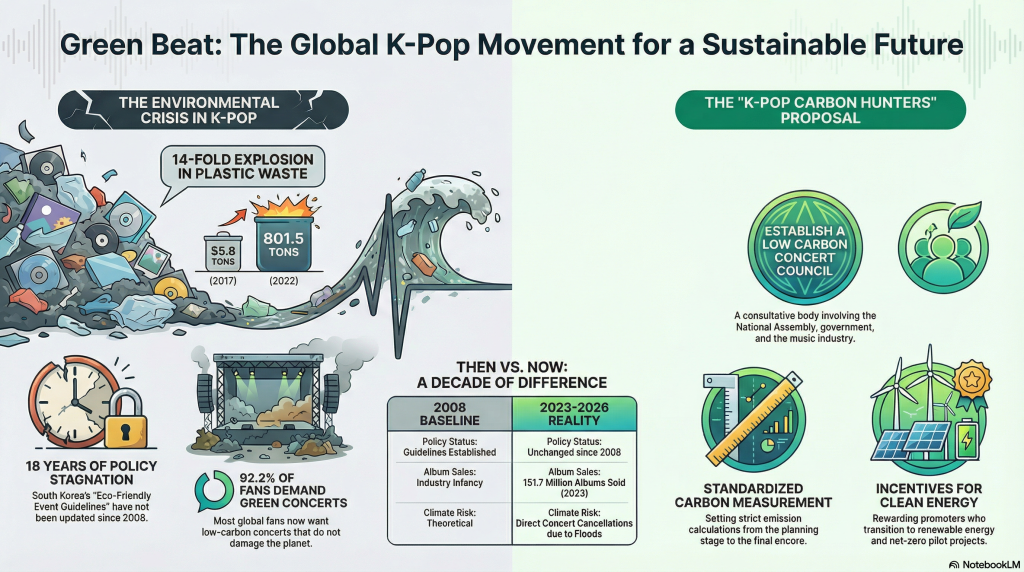
Activists submitted proposals to MP Park Soo-hyun. They propose creating a Low-Carbon Concert Council. This body would unite regulators and entertainment companies.
Key recommendations include:
- Mandatory carbon measurement across event lifecycles
- Incentives for renewable energy adoption
- Digital or QR-based album alternatives
The goal is systemic reform, not symbolic gestures.
Why This Matters Beyond K-Pop
K-pop is a global cultural export.
Standards set in South Korea influence international touring norms. Artists such as Coldplay and Billie Eilish already promote sustainable touring models.
If K-pop adopts strict carbon frameworks, global promoters may follow. The live music industry could see structural change.
Key Data Snapshot
- 92.2% of fans demand low-carbon concerts
- 10,000 signatures collected globally
- 97 countries participated
- Plastic waste increased from 55.8 to 81.5 tons
Conclusion
K-pop’s growth strategy delivered global success. Now it faces environmental and regulatory pressure. Fans are demanding measurable action. Governments are beginning to listen.
The industry must decide quickly.
Adapt to sustainability expectations or risk long-term erosion of trust. In today’s market, ESG performance is no longer optional.
Join us on Kpoppost’s Instagram, Threads, Facebook, X, Telegram channel, WhatsApp Channel and Discord server for discussions. And follow Kpoppost’s Google News for more Korean entertainment news and updates.