


As their second anniversary approaches, K-pop girl band BABYMONSTER is struggling to establish itself as YG Entertainment’s flagship act. Debuting as YG’s new girl group since BLACKPINK, BABYMONSTER were immediately positioned as the successors to one of the industry’s most influential acts. With a fifth-generation trend underway and expansion strategies in place, their position is now being tested. So, is it reasonable to build a new group identity under the shadow of their predecessors, or should they allow themselves to grow without the burden of the successor label?
BABYMONSTER: The “Successor Narrative” Problem



Many were certainly disappointed when BABYMONSTER debuted, as they felt the group possessed extraordinary talent. In fact, many questions arose as to why the group hadn’t truly exploded in the K-Pop industry, even though BABYMONSTER had already won numerous music program awards.
Some netizens even commented that the biggest criticism came from the music. “Their songs are weak, that’s the main problem,” wrote one netizen.
Comparisons to BLACKPINK were also difficult to dismiss. The similarity in concept led some to believe BABYMONSTER hadn’t completely broken free from the influence of their seniors, especially since BLACKPINK is still at the peak of global popularity.
Inconsistent Strategy or Strategic Confusion?
Public pressure isn’t the only factor shaping BABYMONSTER’s journey; the talented group’s comparison to BLACKPINK is only the phenomenon that actually fuels these questions.
1. Musical Direction Shifts
According to The Korea Times, the group, heavily promoted as trainees, initially stumbled with their 2023 pre-debut track, “Batter Up.” Without Ahyeon on the track, the song was underperforming and faced criticism for its outdated concept.
Then, surprisingly, YG changed strategy by bringing back Ahyeon for BABYMONSTER’s official debut in early 2024, and the move had an immediate positive impact. Their first mini-album sold over 400,000 copies in its first week, setting a record for the highest debut sales for a girl group at the time. Their popularity was further bolstered by “Sheesh” and “Drip,” which were considered successful at addressing “Batter Up” ‘s shortcomings and at emphasizing YG’s signature hip-hop style.
However, this momentum was short-lived. The single “Hot Sauce” drew criticism for its outdated concept, while the mini-album “We Go Up” was also deemed to have failed to meet market expectations.
2. YG’s Post-BLACKPINK Positioning
Although the group still has a chance to prove themselves, the pressure on them increases with YG’s announcement of the “YG Special Audition 2026: Go! Debut.” YG founder Yang Hyun-suk personally presided over the auditions, aiming to find new talent on a large scale who could one day fill the shoes of BIGBANG and BLACKPINK.
Meanwhile, BLACKPINK is currently under an exclusive contract with YG for group activities. This situation effectively leaves YG relying solely on TREASURE and BABYMONSTER as its main groups. YG’s aggressive search for BLACKPINK’s successor has created an awkward situation for BABYMONSTER, a group touted as “the next BLACKPINK” from the start.
This is one indication that YG is making a strategic move that seems to contradict the narrative that BABYMONSTER is the next flagship, as it opens up a huge opportunity for new talent.
The Ethical Dilemma in Idol Branding
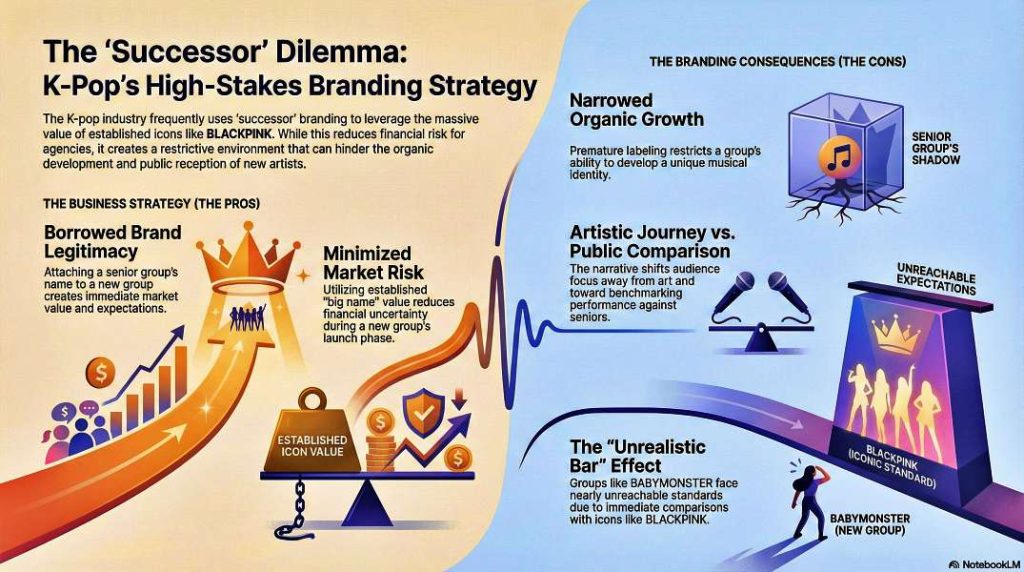
In the highly orchestrated K-pop industry, a pattern like the one just mentioned is actually quite common. New groups are often introduced with the label “successor” to their seniors, as a quick way to borrow legitimacy and create market expectations from the start. From a business perspective, this makes sense. A big name like BLACKPINK already has value that can be “attached” to a new face, thus reducing uncertainty and minimizing market risk.
But that’s where the problem arises.
When a group is labeled a successor even before their sound and musical identity have fully formed, their room for organic growth narrows. This, in turn, prompts the public to ask: Are they on par? The successor narrative unwittingly shifts attention away from the artistic journey and toward premature comparisons.
In BABYMONSTER’s case, the label of BLACKPINK’s successor may have brought immediate attention, but it also set a bar that is almost unrealistic to achieve in such a short time.
Defining Their Own Era
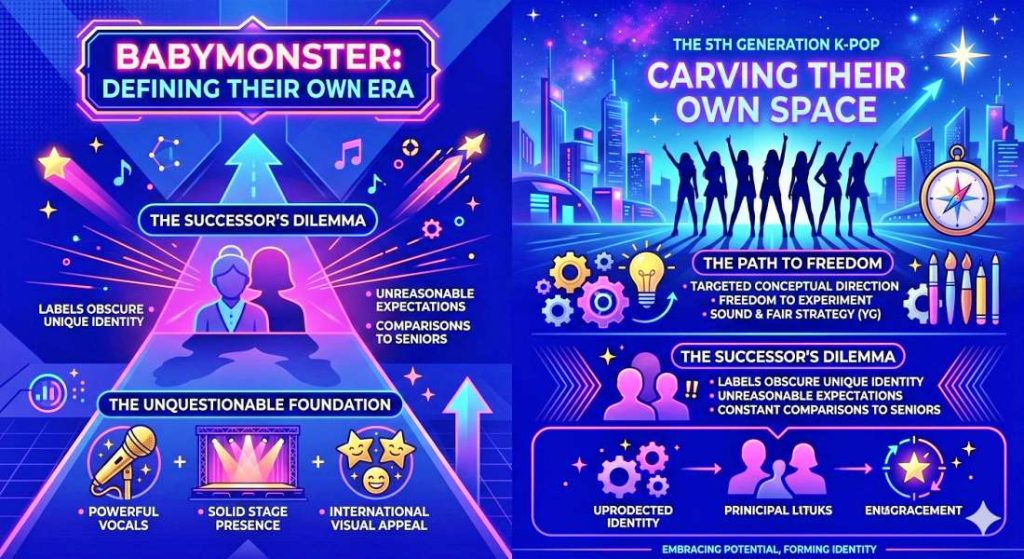
When it comes to talent, K-pop girl group BABYMONSTER is almost unquestionable. The members are recognized for their powerful vocals, solid stage presence, and visual appeal that meet international industry standards. Observers agree that, as artists, their foundation is actually very strong.
But tension stems from the narrative surrounding them from the start. The label of “successor” carries expectations far beyond what is reasonable for a group still in its infancy. Constant comparisons to their seniors can slowly obscure their own identity, which is still being formed.
With more targeted conceptual direction and the freedom to experiment, they still have a real chance to carve out a place that is truly theirs in the fifth generation of K-pop. Of course, with YG Entertainment’s strategy being sound and fair.
Join us on Kpoppost’s Instagram, Threads, Facebook, X, Telegram channel, WhatsApp Channel and Discord server for discussions. And follow Kpoppost’s Google News for more Korean entertainment news and updates.