
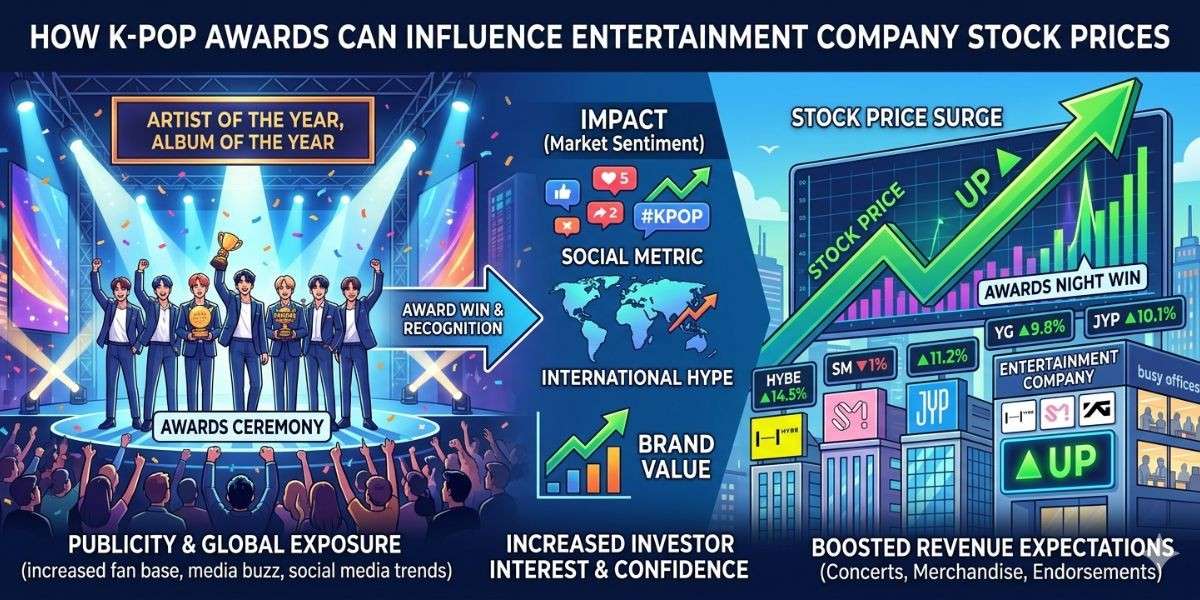
K-Pop awards ceremonies have emerged as significant events in the global entertainment landscape, where artists’ awards can influence financial markets, directly impacting entertainment companies’ stock prices, either positively or negatively. However, this impact is not always long-term. In some cases, stock price increases are short-lived due to market sentiment and intense media attention. Therefore, this article explores how these prestigious ceremonies generate Abnormal Returns (AR), challenging traditional business models by linking cultural success to economic outcomes.
How K-Pop Awards Affect Entertainment Company Stock Prices

Award announcements can change how investors view entertainment companies in the stock market. Various studies indicate that the stock prices of companies affiliated with award recipients tend to increase following the announcement.
This increase is driven by investors’ tendency to interpret awards as indicators of solid performance and future growth prospects. When an idol group achieves public recognition, investors often perceive the management company behind it as having a greater capacity to generate profits.
This belief ultimately drives a surge in demand for the company’s shares. Increased investor buying interest also boosts share prices in the financial markets. This demonstrates how achievements in the entertainment industry can have a tangible and measurable financial impact.
Factors Affecting the Impact of Awards on Stock Prices
Not all awards have the same impact; research suggests companies and investors are selective about the types of awards they value.

Reputation and Scale of Awards
Prestigious global and national events, characterized by high ratings and international coverage, generally have a greater impact on global sales expectations and potential world tours. Conversely, smaller-scale or highly specific awards tend to have only a short-lived effect, with little impact on company valuations.
For example, a report noted that the Asia Star Entertainer Awards (ASEA) held in May 2025 underscored K-pop’s global dominance, with top-tier agencies achieving wins that directly impacted market confidence. ENHYPEN, aespa, and BTS all won Best Album, Best Artist, and Best Song, respectively. These wins boosted investor confidence, as evidenced by subsequent stock movements.
Previous Sentiment Conditions
The market conditions leading up to the announcement also determine the magnitude of the reaction. When investor sentiment is already very optimistic, for example, due to a flurry of positive rumors or a solid chart performance, an award win can trigger a momentary overreaction, followed by a correction. Research by researchers shows that this pattern is usually observed in positive abnormal returns on the announcement day, followed by a return to normal levels shortly thereafter.
The reverse also applies. If the market was previously plagued by concerns about a scandal or a weakening sales trend, an unexpected win can potentially trigger a much larger positive re-rating, as investors’ initial expectations were already low.
Investor Reaction and Abnormal Return in the Financial Market
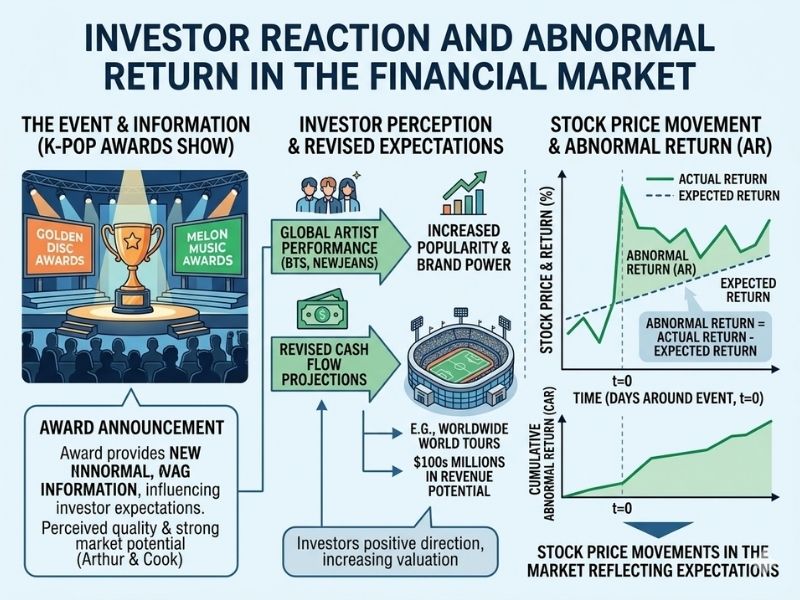
In financial market research, unusual stock price changes following an event are referred to as abnormal returns (AR). These returns occur when a stock’s actual return differs from what investors typically expect.
Award announcements can trigger abnormal returns because they provide new information that can influence investor expectations. Investors often perceive award-winning companies as having higher quality or stronger market potential. The study cited by Arthur and Cook further examines perceived quality, which is reflected in the performance and popularity of corporate idols.
For example, K-pop music awards shows like the Golden Disc Awards or the Melon Music Awards serve not only as recognition of artistic quality but also as economic signals regarding future earnings potential. Wins by global artists like BTS or NewJeans often fuel market expectations for international expansion opportunities, including large-scale world tours that can generate hundreds of millions of dollars in revenue.
These expectations then encourage investors to revise companies’ cash flow projections in a more positive direction, which is ultimately reflected in market stock prices.
Conclusion
As indicators of quality and success, K-pop awards can strengthen investor confidence in entertainment companies and potentially drive stock price changes.
The relationship between entertainment achievements and financial performance highlights the growing interconnectedness between culture and economics. As K-pop’s global influence continues to expand, understanding how awards influence investor behavior and abnormal returns in financial markets will become increasingly important.
Join us on Kpoppost’s Instagram, Threads, Facebook, X, Telegram channel, WhatsApp Channel and Discord server for discussions. And follow Kpoppost’s Google News for more Korean entertainment news and updates.