


Asian entertainment has changed a lot. Japanese dramas used to lead, but now Korean pop culture dominates worldwide. Japan focuses on its huge home market with quieter, niche appeal, while Korea goes big with flashy, high-budget global campaigns. Let’s dive into Japanese versus Korean entertainment industry. We will look at how these two industries work differently, direct the global entertainment trends, and compete for fans around the world.
Zooming into Global Entertainment Trends with Taiga Kunii
To better understand these industry shifts, I sat down for a conversation via ZOOM with Taiga Kunii, an expert in the field. Kunii, who is currently publishing a book titled “Fandom First,” provides a unique perspective shaped by his international background and his work consulting for Japanese artists and virtual agencies. Our discussion delved into how the Japanese drama/movie industry can learn from Korea’s global success while maintaining its unique storytelling “juice.”

The Global Category Battle: Why Japan is Catching Up
Discussing the Japanese versus Korean entertainment, let’s start by looking at its primary difference between: their initial market positioning. Korea has successfully established “K-drama” and “K-movie” as a unified global category, whereas Japan missed its early opportunity to scale its “J-category” worldwide.
“Korea already made that status of, like, K-drama, K-movie, as one category… Japan missed that opportunity of growing that more globally.”
While Japan is now seeing a revival in cinema and global interest through titles like “Shogun” and “Godzilla,” it remains more focused on niche marketing compared to Korea’s aggressive global distribution through platforms like Netflix.
Storytelling vs. Flash: The Godzilla Case Study

When comparing the creative output of a Japanese drama/movie to its Korean or Western counterparts, the focus often shifts from high-budget spectacle to internal narrative.
Kunii highlighted the recent Japanese Godzilla film, which was produced with a budget significantly lower than the US version but yielded higher profit through its focus on the “why” of the monster.
“Japan always thinks of the niche and minor markets… Nothing fancy, nothing flashy, but what we think of is the daily small things of life, or the mission, or the storytelling.”
While Korean content provides an “instant boost” of excitement, Japanese content aims for a “long-term effect” that stays with the viewer years later.
The Loyalty Factor: Why Japanese Fandoms Outlast Trends

As we all know, Korean entertainment is built on fandom loyalty. However Japan has had it long before the Korean wave attacks. The structure of fandom in Japanese Entertainment is built on decades of loyalty rather than the pursuit of what is currently “fresh.”
In Japan, fan clubs are massive, paid businesses where members might stay subscribed for 20 to 30 years, treating the fee like a monthly utility bill.
“Japanese fans last longer than Korean fans… Japan has a group, called Arashi. The fans that are mothers are still under the fan club for, like, 20 years or 30 years.”
This loyalty is maintained through a unique “fear of missing out” (FOMO), where stopping payment means losing one’s “rank” and the chance for front-row tickets in the future. Here’s another difference. Japanese versus Korean entertainment fans have different standard of being FOMO. In Korean entertainment industry, fans fear to be left out if they don’t follow trends.
Breaking the “Island Mindset”: Strategic Priorities for Japan
For Japan to compete more effectively on the international stage, it must overcome its “domestic-first” approach and “island way of thinking.”
Kunii pointed out that Japanese artists often rely on agencies that lack global strategy or “Global Business” divisions that have no real authority. He suggested three priorities:
- reforming company structures to give global teams decision-making power,
- taking a more hands-on approach to international live business,
- and moving away from a reliance on external agencies.
As he puts it, “the leaders or executive needs to be hands-on with the global, plus Japan” to bridge the gap in speed and understanding.
Agility Over the “Big Boss” System: Lessons from HYBE

Taiga Kunii expresses a strong preference for the operational model used by Korean entertainment giant HYBE. He particularly points out its use of sub-labels for different groups. This structure is highly effective for risk management. If one label or artist faces challenges, the parent company remains stable because the groups are categorized independently.
For example, a situation involving a group like NewJeans doesn’t necessarily derail the plans for a BTS comeback. This setup isn’t just a safety net. These smaller, dedicated teams are much faster at making decisions and have more room to be creative.
In contrast, the traditional Japanese industry often relies on a “big boss” system, where a single executive handles every artist under a label. Kunii notes that this centralized approach often lacks speed and creativity because the leader cannot possibly know the intimate details of every artist’s day-to-day needs or market trends.
A critical part of this structural reform involves redefining the role of a manager. In Japan, the mindset has historically treated a manager as a “roadie” or “babysitter”—a 24/7 job that involves staying with the artist at all times. Kunii suggests that the industry must shift toward the Western model, where the manager is viewed as a business partner. By separating day-to-day care from strategic business development, companies can bridge the gap in global competitiveness.
“Introvert Marketing” and the Art of the Detail
A fascinating aspect of Japanese marketing is its meticulous attention to detail. Kunii explores this in his upcoming book, “Fandom First.” This book mashes up 50 different case studies to illustrate Japanese marketing strategies and ideas that Kunii describes as uniquely “introvert-oriented.”
Unlike the American or Korean styles, which might focus on broad appeal, Japanese marketers may spend months researching the exact length and light reflection of a keychain to ensure it swings perfectly on a fan’s backpack.
Kunii noted that this “introvert-oriented otaku geeks coming up with marketing idea” is a unique strength that allows Japanese content to resonate deeply with specific subcultures globally.
The “Slow Burn” Strategy: What Korea Can Learn from Japan’s Playbook
While the Korean entertainment industry currently dominates global PR and distribution, there are structural and creative strengths in the Japanese model that offer a blueprint for even greater sustainability.
One of the most significant lessons is the cultivation of unwavering fandom loyalty. Unlike the Korean market, where fans often move quickly toward the next “fresh” or “dynamic” trend, Japanese fans are known to stay in paid fan clubs for 20 to 30 years, treating their membership like a monthly utility bill. By emulating this “devoted and loyal” structure, Korean agencies could create more stable, long-term revenue streams that aren’t entirely dependent on the immediate success of a single comeback or release.
Furthermore, Korean creators can look to Japan’s success in storytelling over spectacle. While Korean content often provides an “instant boost” through high-budget visuals, Japanese content tends to focus on the “juice” of the narrative—the small, daily details of life that leave a “long-term effect” on the viewer.
As Kunii suggested, instead of relying on flashy effects, Korean producers could “dig deep” into their vast libraries of webtoons to find stories that resonate on a deeper, more permanent level, ensuring their content isn’t forgotten as soon as the audience leaves the cinema. Finally, adopting a touch of Japan’s “introvert-oriented” marketing—which focuses on meticulous, niche details that speak directly to specific subcultures—could help Korean entertainment build even stronger, more personal connections with global audiences.
Key Takeaways: Japanese versus Korean Entertainment Global Trends
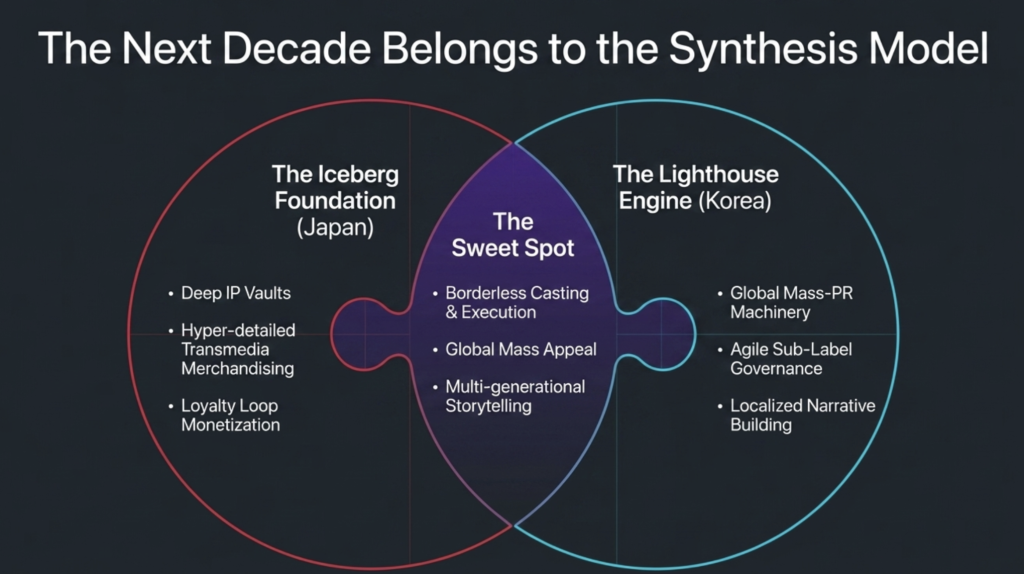
- Global Categorisation and Brand Power: Korea has successfully established “K-drama” and “K-movie” as powerful global categories. This status is so strong that international audiences will often watch new content simply because it falls under the “K” umbrella, a global branding opportunity that Japan missed in previous decades.
- The Necessity of Global Reach: Because the Korean domestic market is roughly half the size of Japan’s, the industry cannot sustain itself on local revenue alone. Consequently, Korean companies have developed a heavy PR and global distribution strategy, partnering with giants like Netflix and Hulu to ensure their high-budget projects recoup their investment internationally.
- Immediate Spectacle vs. Long-Term Juice: Korean content is characterized by being flashier, high-budget, and visually immediate, utilizing advanced FX and CG to capture global attention quickly. While this provides an “instant boost,” it contrasts with the Japanese approach of “gradual juice”—storytelling that aims for a long-term emotional memory years after viewing.
- Dynamic Fandom and Digital Priority: Korean fans are perceived as more dynamic and trend-oriented, often canceling subscriptions to move toward whatever is “fresh” or currently popular. They are also highly strategic digital supporters; for instance, K-pop fans may buy physical CDs for fan-meeting lotteries but prioritize streaming on Spotify to help their favorite group’s global ranking.
- Structural Agility (The HYBE Model): A major strength of the Korean industry is the sub-label structure pioneered by companies like HYBE. This model allows for better risk management—if one group faces challenges, the parent company remains stable—and fosters faster decision-making and creativity compared to the centralized “big boss” system common in Japan.
- Management as a Strategic Partnership: Unlike the Japanese model where a manager often acts as a “roadie” or “babysitter,” the Korean and Western models increasingly view the manager as a strategic business partner. This allows artists to have a dedicated team for day-to-day needs while a separate professional focuses on global business development.
- Revenue Streams and Licensing: While Japan derives massive revenue from niche merchandise and transmedia (such as paid fan clubs that generate millions locally), the Korean model is heavily optimized for distribution, streaming, and global licensing.
- Aggressive Global Talent Acquisition: Korean companies have become leaders in global auditions, forming groups with international members to ensure a global footprint from day one. This proactive approach contrasts with the “island-minded” and slower domestic-first strategy often seen in Japan
Join us on Kpoppost’s Instagram, Threads, Facebook, X, Telegram channel, WhatsApp Channel and Discord server for discussions. And follow Kpoppost’s Google News for more Korean entertainment news and updates.











Interesting point of view!