


Many brands assume that product placement in a K-drama is just a matter of budget. But marketing expert Joon Kim says that is completely wrong. According to him, timing and access matter far more than budget.
This changes everything about how brands conventionally think about how they should approach K-dramas. Getting your product into a show is just the beginning; what happens after the show airs is where things really take off. So, how does smart product placement actually work in today’s K-drama world? Let’s break it down.
Joon Kim’s Placement Strategies: How to Get Your Product Into a K-Drama



It all starts with challenging one of the biggest myths in K-drama marketing — that budget is everything. Many brands believe that a bigger budget guarantees more opportunities. But the reality is the opposite.
Co-founder and Chief Marketing Officer (CMO) of AJ Marketing, Joon Kim, emphasized that K-drama placement is not about how much money you put in. It’s about when you show up and who you talk to.
Many brands wait until a Korean drama goes viral, then try to jump in. By then? It’s too late.
That is why having a K-drama placement strategy is crucial for market relevance. The brands that stand out aren’t those with the biggest budget or chasing trends. Instead, true winners are those who establish a strategic position long before the drama begins production, solidifying their roles.
Joon Kim’s 6-Step Playbook for Your Brand Getting Into a Korean Drama

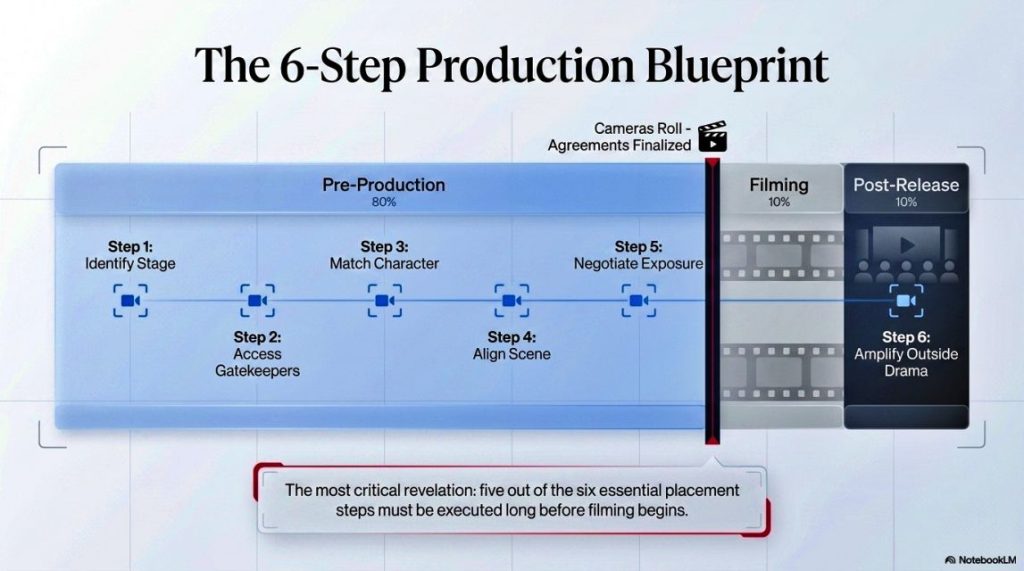
In his six-step framework “How to Actually Get Your Brand into a K-Drama,” Joon Kim outlines strategies for securing placements in the K-drama world. Here’s how it works:
1. Identify the right stage
In marketing, savvy brands should enter the production ecosystem before filming begins, as negotiation and integration take time. By the time filming begins, all placement agreements are already finalized.
2. Work with the right gatekeepers
Brands don’t pitch directly to Netflix or major distribution platforms for a spot. Instead, they work through three key channels: production companies, local agencies, and distribution partners. These are the real gatekeepers.
3. Match product to character
Match your product to the right character. These days, the question isn’t “Where can we squeeze in our product?” The new question is, “Which character would actually use this?”
A placement that fits the character feels like part of the story. One that doesn’t? The audience notices immediately.
4. Align with scene context
Each scene carries its own meaning. So, pick the right scene, as not every scene is created equal. The best scenes for product placement fall into three categories: everyday routines, emotional moments, and relationship scenes. These feel the most natural and the most memorable.
5. Negotiate exposure
Once you have found the right scene, it’s time to get into the details. How many seconds does your product appear? Is it in the foreground or background? Does a character mention it out loud? How many episodes does it show up in? All of this gets negotiated.
6. Amplify outside the drama
This is the step most brands completely skip, and it’s a huge mistake. Joon Kim puts it plainly: “Placement is just the start. Distribution is where the ROI happens.”
After the drama airs, brands must actively execute multi-channel marketing strategies, including pushing clip scenes on social media, partnering with influencers, and tapping into K-drama fan communities to keep the conversation alive.
What It Really Takes to Nail a K-Drama Placement
The six steps are just the foundation. Joon Kim shares three key insights that separate brands that get it right from those that don’t, from avoiding common pitfalls to finding the formula that drives real results.
Flashy Doesn’t Mean Effective
The most common mistake brands make is going way too flashy. A forced placement feels like a random commercial dropped into the middle of a scene, and viewers catch it right away. As Joon Kim explains:
“A product placement that is too flashy, so it does not fit the character or the storyline. Great product placement should feel like it belongs in the scene, not the opposite. It also has to be realistic to the character. For example, the character is written to be a struggling, middle-class employee so that luxury brands won’t fit.”
Joon Kim.
How to Access Gatekeepers Without Industry Connections
For brands new to the K-drama ecosystem and without industry connections, working with a trusted agency is the smartest move. As Joon Kim puts it,
“Definitely, by connecting with a trusted agency, it will make the process smoother, easier, and lower the risk. Product placement is a big investment and time-sensitive. No room for “figuring it out,” leave it to the experts.”
Joon Kim.
The Formula for High-Impact Placement
Following the right process matters, but success comes down to knowing what to watch for. According to Joon Kim,
“Keep an eye on the key storyline, actors, and production house. A booming K-drama mix with subtle product placement = success. Post-airing amplification is definitely crucial. Partnering with k-drama enthusiasts, k-drama news, or pages on Instagram.”
Joon Kim.
Effective Brand Placement Takes More Than Just Budget
K-drama placement isn’t a money game — it’s a strategy game. As Joon Kim points out, the right timing, connections, and structured execution are crucial factors in marketing. He also emphasizes that successful brands are those that plan ahead, not the ones that chase trends.
The key is to get in early, work with the right partners, and make sure your product feels natural to the characters and story. And when the show ends, the work isn’t over. Multi-channel marketing is what turns a single placement into a lasting impact. In the K-wave era, off-screen conversations are just as powerful as on-screen ones.
Key Takeaways
- Timing Over Budget: Early entry into the production process matters more than spending big. Brands that get in ahead of time have a significant advantage.
- Plan Early, Not Late: Chasing trending shows is not a winning strategy. Brands should build their approach from the earliest stages of production for a more natural fit.
- Access is Everything: The path into K-dramas is through production houses and agencies, not major platforms like Netflix or streaming services.
- Subtle Placement Wins: A quiet, well-fitted placement that matches the character and story is far more effective than a flashy, forced one.
- Multi-Channel Marketing Drives Impact: Real impact happens after broadcast. Amplifying your placement through social media, fan communities, and influencers is what creates lasting results.
Join us on Kpoppost’s Instagram, Threads, Facebook, X, Telegram channel, WhatsApp Channel and Discord server for discussions. And follow Kpoppost’s Google News for more Korean entertainment news and updates.