

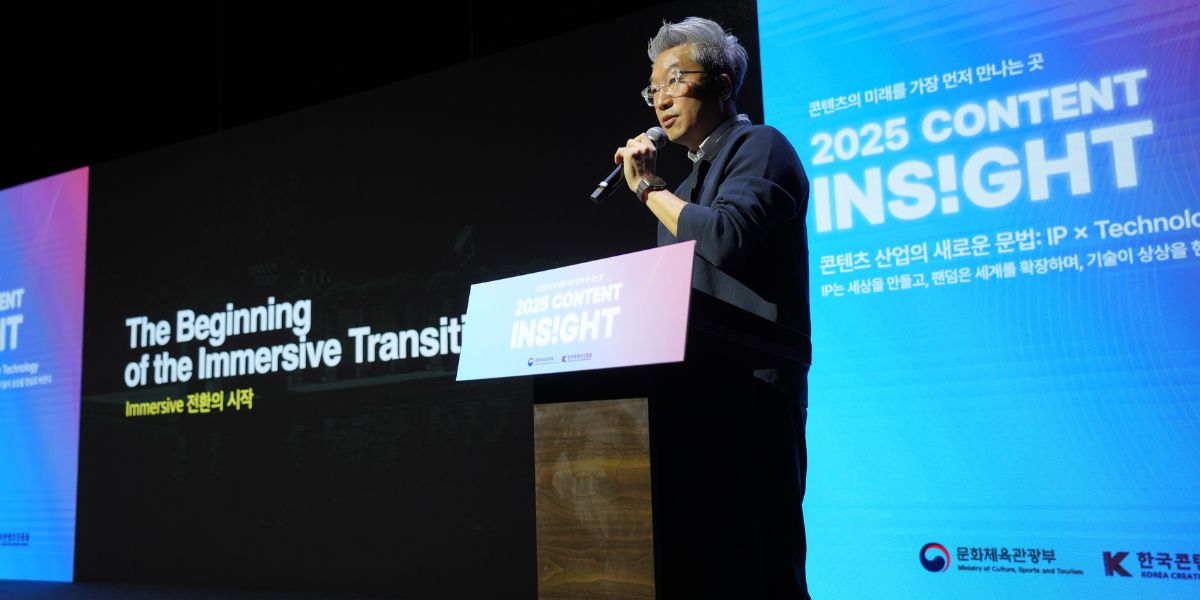
At KOCCA 2025 Content Insight, Lee Ji-chul of Giantstep explores how AI, XR, and virtual idols are redefining the future of Korean entertainment. He took the stage to share a bold vision of how technology is not just transforming K-pop but expanding what it means to feel connected through music. With the topic of “Immersive K-POP: The Future of IP Production Redefine by Virtual Idols and Technologies,” Lee Ji-chul open our eyes to the future of K-pop.
Future of K-Pop: Where Technology and Emotion Meet
“K-pop is not merely a music genre,” Lee began. “It’s a cultural system — one that evolves with every technological leap.”
As co-CEO of Giantstep — the powerhouse behind groundbreaking immersive experiences — Lee has long stood at the crossroads of creativity and code. From leading projection mapping at the 2018 PyeongChang Winter Olympics to producing the immersive “D’Festa” showcase and co-developing the virtual idol project “Skins”, Lee’s work demonstrates how Korea’s entertainment industry continues to set global standards for creative innovation.
Technology Redefining the Rhythm of K-pop



Founded in 2008, Giantstep started as a visual effects studio serving the top K-pop labels. Over the past 15 years, the company has evolved into a tech-driven creative studio, pioneering metaverse, XR, and AI applications for the music and media industries.
Tracing the four generations of K-pop idols, Lee highlighted how each era has mirrored a corresponding wave of digital innovation — from the rise of television fan clubs to YouTube, TikTok, and immersive fandom platforms.
“Each generation of K-pop changed how content is consumed. Technology doesn’t just support music — it shapes how fans participate in it.”
Lee Ji-chul.
From early music videos to real-time virtual stages, the partnership between entertainment and technology has continued to deepen. K-pop’s global dominance, Lee argued, is built on this ongoing fusion of creativity and computation.
The Fusion of Technology, Story, and Emotion
When live concerts halted during the pandemic, K-pop faced a creative crossroads. Yet rather than retreat, the industry reinvented itself through digital experience.
Projects like Beyond Live — a collaboration between SM Entertainment and Naver, powered by Giantstep’s Unreal Engine-based virtual stage — enabled fans to attend concerts from home while still experiencing the emotional charge of a live performance.
Later came JTBC’s “New Festa” and the celebrated “D’Festa” exhibition, where nine top idol groups performed across physical, cinematic, and virtual worlds.
“D’Festa was a turning point. It proved that emotions could be conveyed through pixels. Technology became not a barrier, but a bridge.”
Lee Ji-chul.
In one installation, Giantstep digitally recreated Seoul Forest, producing a 3D stage where every element — lighting, camera work, and set design — existed entirely in virtual space. This approach has since become the foundation for modern immersive K-pop experiences.
From the Virtual Stage to Virtual Idols
As digital concerts matured, a new kind of performer emerged: the virtual idol.
Groups such as PLAVE, APOKI, and aespa’s æ-members now stand alongside human artists, blending narrative and technology into new hybrid realities.
“These are not mere avatars. They’re artists with stories, emotions, and worlds of their own.”
Lee Ji-chul.
Giantstep’s collaboration with SM Entertainment on the æ-universe and the fully virtual artist NÆVIS exemplifies this evolution. Here, storytelling and software merge to blur the line between the real and the imagined — not to replace humanity, but to expand it.
Creating Virtual Idols: The Technology Behind Emotion

To bring emotional depth to digital performers, Giantstep developed SKINZ, a seven-member virtual idol group launched with SBS and Bridge Entertainment. SKINZ became the first Korean virtual idol group to debut at Tokyo Dome — a symbolic moment for the future of entertainment.
Behind the scenes, Giantstep utilizes real-time rendering, facial motion capture, and AI emotion modeling. Each avatar is built on photogrammetric scans that capture up to 100 micro-expressions per model, teaching AI how to recreate natural emotional movement.
“Our goal isn’t realism for its own sake. It’s emotional authenticity — technology that feels human.”
Lee Ji-chul.
The company’s collaboration with Naver on Sori, a real-time virtual human performer, further illustrates this principle. During LED stage performances, virtual and real lighting merge seamlessly, letting fans interact with avatars in real time — proof that technology can deepen empathy rather than diminish it.
Tools for a Virtual Era
As digital idols multiplied, so did the need for digital fashion. Giantstep answered with a modular design system initially created for K-pop avatars but now expanding into gaming, fashion, and performance design. It allows real-time customization — from lace texture to outfit silhouette — enabling creative teams to experiment like “building with Lego blocks.”
This agile approach not only streamlines production but redefines K-pop’s aesthetic language for the metaverse generation.
AI: The New Creative Partner
According to Lee, the industry has entered “a singularity where technology and creativity meet.” At Giantstep, AI is now integral to every stage of content creation — from storyboarding and modeling to animation and rendering.
In one groundbreaking case, the studio produced an AI-generated music video in just ten days, combining director-led storytelling with the speed of generative AI.
Giantstep also collaborated with HYBE and Supertone on the MIDNATT project, which used AI voice synthesis to deliver a multilingual song that maintained emotional nuance across six languages.
“AI isn’t here to replace artists. It’s here to amplify imagination.”
Lee Ji-chul.
The Future: K-pop as a Creative Ecosystem
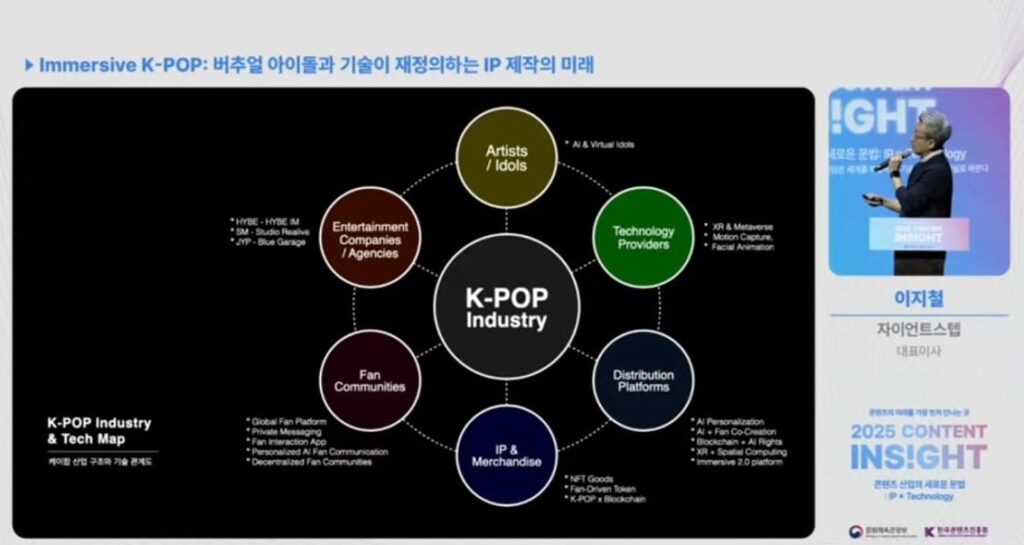
Lee envisions a near future where AI and virtual production integrate every layer of the entertainment value chain — from planning to performance, distribution to fandom.
Emerging projects such as Kihon, a fully AI-generated idol built on the Higgsfield platform, hint at what’s next: personalized artists, co-created by fans and algorithms alike.
“Technology is a new language for emotion. Through it, we’ll express humanity in ways we’ve never imagined.”
Lee Ji-chul.
In this vision, platforms evolve from distributors into co-creators; studios like Giantstep become creative ecosystems; and fan communities turn into collaborative art spaces.
“Ultimately, art imagines — and technology realizes that imagination. The next era of K-pop begins right here, where technology and emotion finally meet.”
Lee Ji-chul.
About Lee Ji-chul
Lee Ji-chul is the Co-Chief Executive Officer and Director of Giantstep Inc., a pioneering Korean studio in immersive technology for entertainment. Since founding the company in 2008, he has led major projects blending metaverse, XR, VFX and AI—helping redefine how K-pop is created and experienced.
Connect with Lee Ji-chul on LinkedIn.
Join us on Kpoppost’s Instagram, Threads, Facebook, X, Telegram channel, WhatsApp Channel and Discord server for discussions. And follow Kpoppost’s Google News for more Korean entertainment news and updates.