
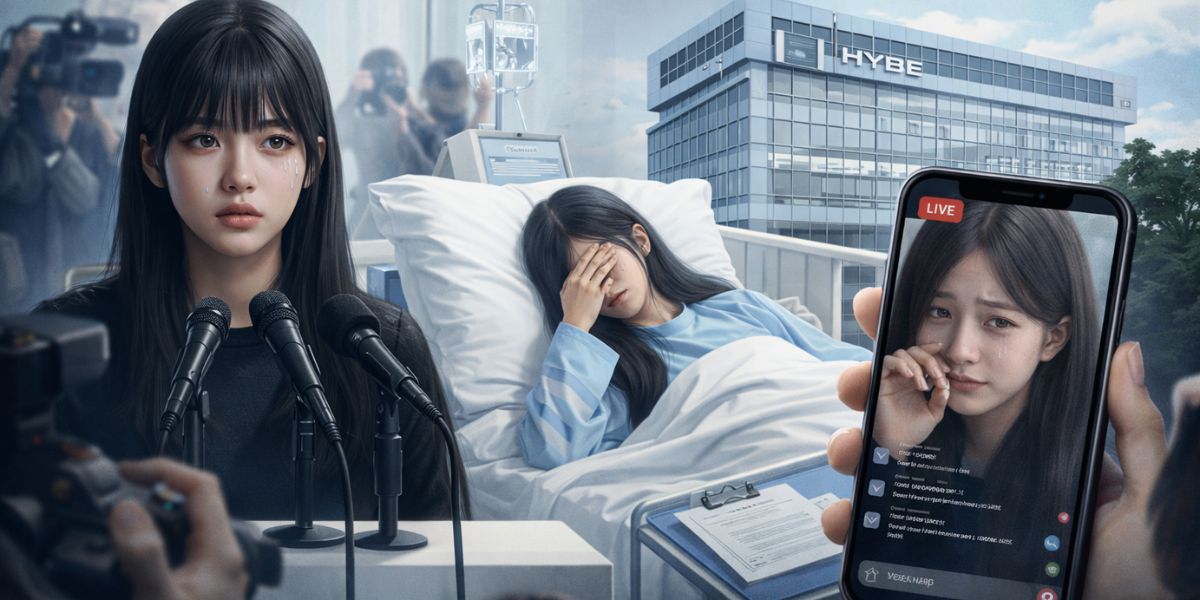
Over the past decade, hiatus announcements citing anxiety or burnout have become increasingly common in the K-pop industry. From group members temporarily halting activities to focus on treatment, to entire group breaks during intense promotional cycles, mental health breaks are no longer rare exceptions but recurring headlines.
Agencies now release carefully crafted statements that prioritize artists’ well-being, indicating a broader cultural shift in South Korea toward greater openness about mental health.
As these breaks normalize, deeper questions arise: beyond public reassurances, how is the industry structurally managing mental health? While support systems may exist at the corporate level, there are still no formal industry-wide standards defining minimum obligations or oversight for protecting idols’ mental well-being.
What Does “Hiatus” Mean in the K-Pop Context?
A hiatus isn’t just a vacation or a regular leave of absence. It’s a temporary halt to an idol’s official activities, announced by their agency. A hiatus can take the form of a temporary suspension, in which one member leaves temporarily, and the group continues without them, or a complete hiatus, in which the entire group’s activities are suspended.
The impacts can vary: delayed comeback schedules, canceled music show promotions, and even adjustments to tour and advertising contracts, as K-Pop relies on a tight, synchronized promotional rhythm among members.
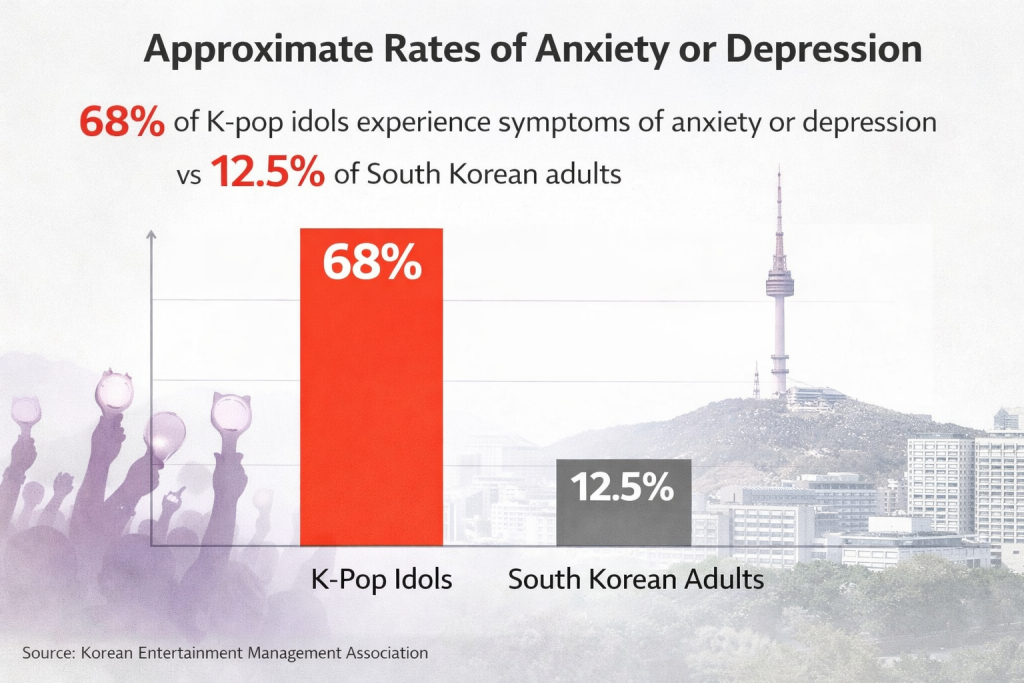
The Korean Entertainment Management Association indicates that approximately 68% of K-pop idols experience mental health symptoms, like anxiety or depression, a far higher rate than the general depression rate of 12.5% among South Korean adults. Some idols who have taken a break include Jeongyeon (TWICE) due to anxiety, Mina (TWICE) also taking a hiatus due to anxiety, S.Coups (SEVENTEEN) taking a break for mental health, and Lia (ITZY) taking a break to focus on her mental health.
Academic research also notes the complex relationship between music fanaticism and mental health. Music can support emotional regulation and social connection, but over-involvement and the pressure of fandom communities can also trigger significant stress or anxiety.
The Current Framework: Self-Regulation Over Formal Rules
The industry has begun to seriously address the mental health of its idols through two channels: internal policies from each agency and increasing regulatory pressure from the South Korean government. Unfortunately, implementation remains inconsistent, as each label has different standards.
1. South Korea’s Regulatory Framework
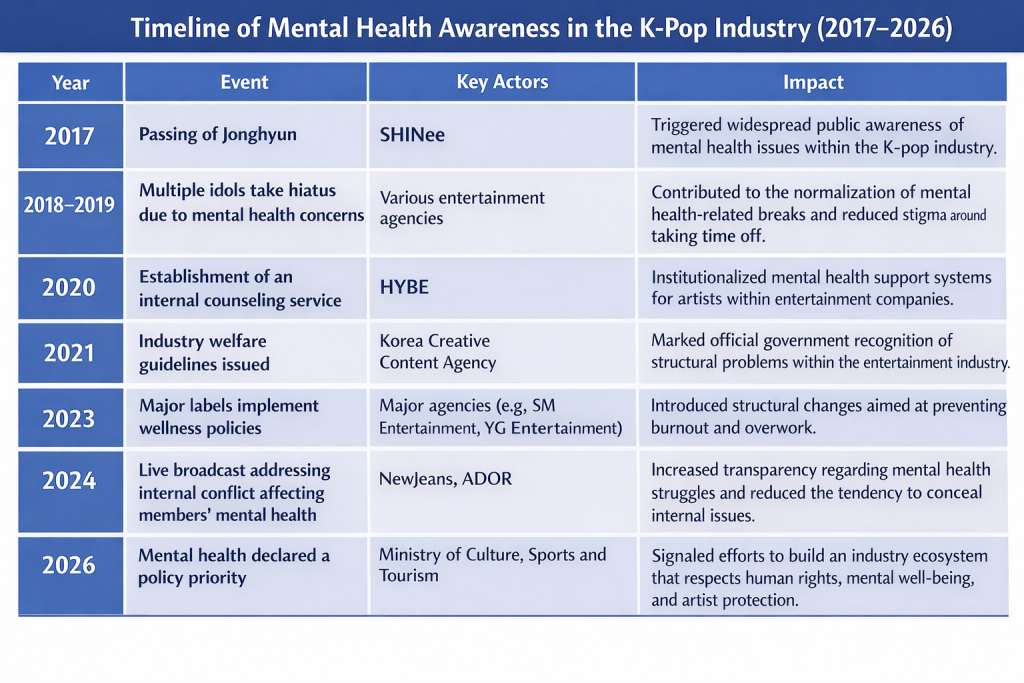
Entering 2026, South Korea took concrete steps by updating the standard contract template for trainees seeking careers as K-pop idols or actors. This change was driven by the need to clarify trainees’ rights, minimize the potential for contract disputes, and establish more transparent compensation rules—both when trainees and agencies terminate their employment. The Ministry of Culture, Sports, and Tourism announced it on December 31st, and it officially took effect on January 1st.
One crucial point is Article 8, which regulates the payment mechanism after contract termination. Beyond the financial aspect, this regulation also addresses mental health issues. A significant change is the expansion of the criteria for receiving counseling services, which previously only targeted trainees with conditions such as “severe depressive symptoms,” to include “symptoms of depression and related conditions,” allowing more trainees to access psychological support without having to wait for their condition to worsen.
2. Agency Initiative
HYBE and SM Entertainment are agencies that already offer free in-house counseling services, with a psychologist available at any time, and flexible career break options for idols experiencing psychological stress.
JYP takes a different approach by utilizing a daily mental health monitoring app for its trainees—if stress indicators show alarming levels, the team intervenes immediately. Meanwhile, Big Hit offers something more unusual: pet therapy sessions to promote relaxation. Ironically, this is often not the case at mid- to lower-tier agencies.
“Korean members, who have trained since childhood, are accustomed to long working hours and rarely voice their concerns. Foreign members face greater difficulties. Major agencies such as Hybe, JYP, and SM operate internal counseling centers, but smaller companies often lack such systems. Idols rarely have the time to seek external mental health support,” said Lee Jong-im, adjunct professor at Kyung Hee University’s Graduate School of Media and Communication.
Mental Health in K-Pop Is Reshaping Korea’s Cultural Landscape
The conversation about idol mental health has an impact far beyond the entertainment industry itself, shifting the mindset of South Korean society, which has traditionally been reluctant to discuss psychological well-being openly. When MAMAMOO’s Wheein spoke candidly about her diagnosis of panic disorder in 2022, mental health hotlines saw a 34% surge in calls in the following week. This figure demonstrates the significant influence idols have had in making these conversations feel more normal and acceptable.
This shift has also extended to fan communities. A more supportive environment has emerged in response to the often toxic fandom culture. The “Purple Ribbon” campaign initiated by BTS ARMY following Jonghyun’s passing is one example.
The fourth generation of K-pop acts, like TXT, aespa, NewJeans, and (G)I-DLE, also brings a different perspective. They enter the industry with a more mature understanding of psychological well-being and are indirectly helping to shape new, healthier standards.
Conclusion
Agencies are taking action. The government is updating standard contracts. However, this system still relies on self-regulation, and uniform industry standards have not yet been fully established.
At the same time, public change is creating a discussion about mental health that is no longer hidden. Now, the industry faces new demands: consistency in structured, transparent psychological protection.
Join us on Kpoppost’s Instagram, Threads, Facebook, X, Telegram channel, WhatsApp Channel and Discord server for discussions. And follow Kpoppost’s Google News for more Korean entertainment news and updates.