

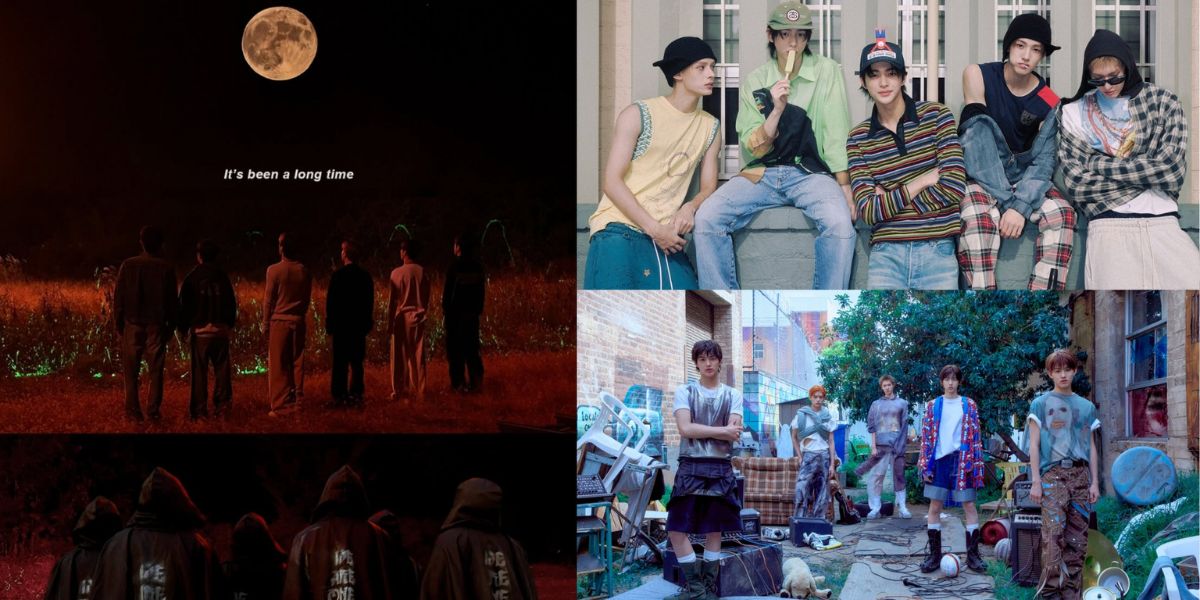
What makes a K-pop concept truly unforgettable? Is it the uniquely crafted universes of groups like EXO or the newer generation CORTIS that are challenging K-pop norms by prioritizing creative freedom and self-defined identity?
For years, K-pop thrived on precision. Entertainment agencies and companies assigned concepts and defined their identities, building the narratives behind each group that became the central story. From the rise of second-generation in the 2000s through the early 2010s, this system propelled K-pop music into a global phenomenon, treating groups as strategically designed intellectual property (IP) assets.
As the third generation emerged throughout the 2010s, K-pop entered what many consider its golden age–marked by iconic universe and multiverse storytelling that deepened the relationship of fandom immersions. Yet in the 2020s, that traditional concept-driven model is being reconsidered and replaced. Rather than asking “What is the concept?”, the industry is posing a different question: “Who is the artist?” Identity is no longer strictly defined by companies but is shaped by the artists themselves, though not entirely, while still allowing concepts to support creative expressions.
The Peak of The Concept-Driven Era
At its golden age, K-pop themes functioned as creative direction and the foundation of a business strategy.
EXO is the most iconic, whose debut mythology positioned its members and narrative to define the group as a distinct concept, helping audiences distinguish it from others. EXO’s concept is not optional or merely an accompaniment to their releases–it structures them and unifies them into one, ironically, hence their fanchant, “We are… ONE!” It was a long-term storytelling device designed to loop fans in and give fans a world to enter rather than just a song to consume.



Concepts served as the backbone of K-pop identity. Group members were assigned clear roles and symbols that together form a whole in which identity is tightly held. Storytelling was centralized, creating long-term immersion and loyalty among audiences and fans.
Why The Traditional Concept System Began to Fracture
By the late 2010s, audience expectations had reshaped the strategy behind K-pop’s rapid global growth, as more artists entered the industry with stronger creative skill sets and music that mapped out their own voices across their projects, making them a little more involved in introducing their creative output and true colors, which audiences value.
The growing number of idols registered with the Korea Music Copyright Association (KOMCA) and International media outlets such as Billboard also began taking creative authorship as a key factor. Seems like artistic participation is becoming central at this point.
CORTIS: “Who is the Artist?”
Rather than functioning as a traditional concept or storyline tied to a specific era or comeback, CORTIS K-pop group formed by Big Hit Music (under HYBE), represents a talent-forward approach that emphasizes artist participation and collaboration in creative processes. Instead of presenting a fixed narrative for audiences to follow, it hones in on the fundamental questions: Who is the artist? What is the identity behind this project itself? It creates an environment in which artists can contribute meaningfully to how their music and identity take shape.

CORTIS 1st EP, “Color Outside the Lines,” released on September 8, has been framed to center self-discovery. Instead of accepting what is given, they embrace their own imperfections and create something new and raw. According to Big Hit Music, the album was a journey that began with a question: “What You Want?” A question that challenged the members to answer in their own language–the identity behind this project. Each member carves out their part of the album with skills to articulate “Who is the artist?”, curating the ultimate five tracks, “GO!”, “What You Want”, “FaSHioN”, “JoyRide”, “Lullaby”, that essentially credit their names.
Their uniqueness and difference in self-identity translated into audience response across the globe; “Color Outside the Lines” achieved chart placements following its release. Coming in hot, debuting at No. 15 on the U.S. Billboard 200 Chart, No.5 on the United World Chart, and attaining several other chart positions. CORTIS has defined the new K-pop strategy as one in which creative freedom and personal expression can coexist with commercial visibility.
Companies Growth: HYBE
From a business standpoint, HYBE’s evolution over the past decade reflects a company operating at an entirely different scale than in its early years. From 2018 through 2023, a system change led to the development of a new system, creating a better and faster way to generate revenue. As the chart from Music Business Worldwide shows, annual performance has increased steadily throughout the process as HYBE’s revenue base expanded from roughly ₩301 billion to over ₩2.17 trillion of Korean Won, representing more than a sevenfold increase in five years.
The graph below illustrates HYBE’s annual financial performances:
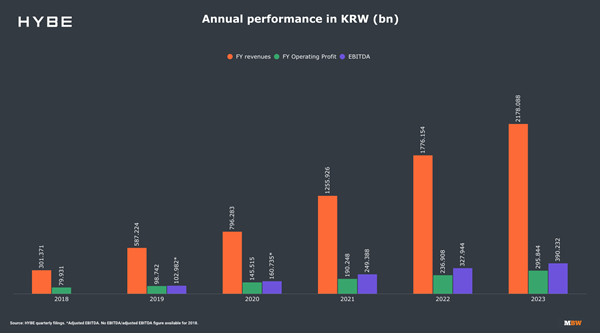
Driven by global touring, intellectual property expansion, and platform-based fan engagement, they distribute creative participation across artists. Systems that foreground artist identity allow the company to scale production and support multiple revenue-generating projects simultaneously without creating a one-for-all concept. It states loudly that the current defining “self-identity” era is working well at a standard pace.
Future Concept: Artist-Defined Identity Strategy
As concepts become more flexible, K-pop is likely to see greater diversity in visual identity. The traditional idea has not been abandoned, nor have any of the historical business strategies that helped build the industry’s global success. Those system proved their effectiveness at scale.
What has changed is how they are applied. As generational shifts reshape audience expectations and artist participation, concepts are less needed. They are only hidden behind the shadows of the artists’ real characteristics and brought back only as a supporting role when necessary.
Join us on Kpoppost’s Instagram, Threads, Facebook, X, Telegram channel, WhatsApp Channel and Discord server for discussions. And follow Kpoppost’s Google News for more Korean entertainment news and updates.











Hi