
No Result
View All Result
KPOPPOST
  • 안녕하세요 – About Kpoppost
  • Hot News
    • Boy Groups & Singers
    • Girl Groups & Singers
    • Kpop New Release
    • Kdrama/Kmovie
    • Variety Shows
    • Rankings
  • Interview
  • Events
  • Lists
  • Story/Profile
  • Korean Fashion & Beauty
  • Quiz & Voting
  • Contact Us
  • Subscribe us
  • Login
  • 안녕하세요 – About Kpoppost
  • Hot News
    • Boy Groups & Singers
    • Girl Groups & Singers
    • Kpop New Release
    • Kdrama/Kmovie
    • Variety Shows
    • Rankings
  • Interview
  • Events
  • Lists
  • Story/Profile
  • Korean Fashion & Beauty
  • Quiz & Voting
  • Contact Us
  • Subscribe us
  • Login
No Result
View All Result
KPOPPOST

How First Week Sales Became the Key KPI in the Global K-Pop Business Model

Jae-sung by Jae-sung
March 16, 2026
in News
0
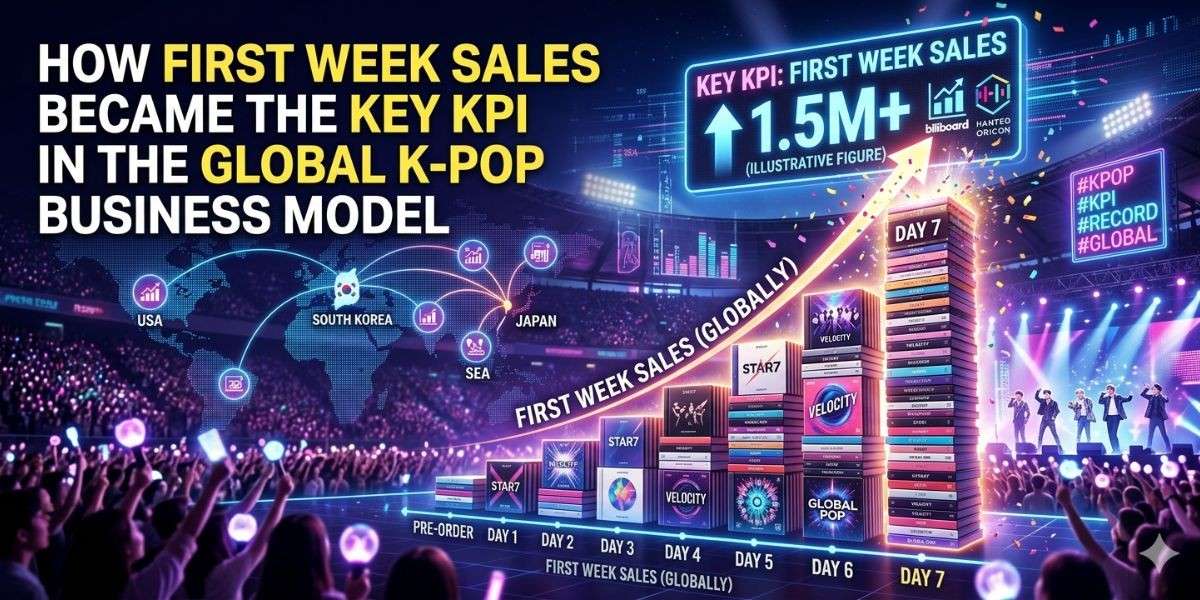
How First Week Sales Became the Key KPI in the Global K-Pop Business Model

Illustration of How First Week Sales Became the Key KPI in the Global K-Pop Business Model

In the global music industry, few metrics carry as much weight as K-pop’s first-week sales. For entertainment companies, the number of album sales recorded in the first seven days after release has become a crucial key performance indicator, signaling an artist’s market power and the scale of their fanbase. Unlike many Western markets, where streaming dominates, the K-pop business model still relies heavily on physical albums and coordinated fan engagement. This dynamic is closely tied to the industry’s robust fandom economy, where fans actively drive sales through organized purchases, making comeback week one of the most crucial moments for an artist’s commercial success.

Table of Contents

Toggle
  • K-Pop First Week Sales as a Key Performance Indicator
    • Album Sales Remain a Pillar of the K-Pop Industry’s Business Model
    • How the Fandom Economy Drives Album Sales in the Music Industry
    • Conclusion
      • 1. First-Week Sales as an Indicator of Fandom Strength
      • 2. First-Week Sales as an Industry Benchmark
      • Related Posts

K-Pop First Week Sales as a Key Performance Indicator

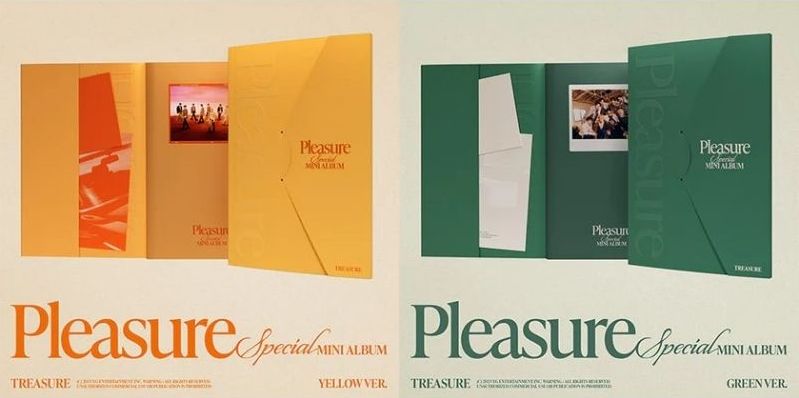
TREASURE’s special mini-album, PLEASURE | YG Entertainment

Today, first-week sales have far surpassed their literal meaning as simply a recap of album sales in the first seven days. For South Korean entertainment companies, this figure has become a key performance indicator to gauge an artist’s influence in the music market. Official charting platforms like Hanteo Chart and Circle Chart allow agencies to monitor sales movements in real time during this crucial period.

Industry reports cited by YG Entertainment highlight that initial sales reflect the strength of an artist’s core fan base. For example, TREASURE’s special mini-album, PLEASURE, topped both album and retail charts for the 10th week of 2025 (March 2 to 8) with 612,398 copies sold. This strong first-week performance serves as the primary benchmark for evaluating a comeback’s success.

From a business perspective, first-week sales data drives strategic decisions, such as scaling international tours, assessing brand appeal, and projecting promotional investments for future projects.

When a group breaks a first-week sales record, it not only boosts the artist but also enhances the entertainment company’s image and global standing. These figures attract industry media attention, expanding the artist’s reach and commercial value.

Album Sales Remain a Pillar of the K-Pop Industry’s Business Model
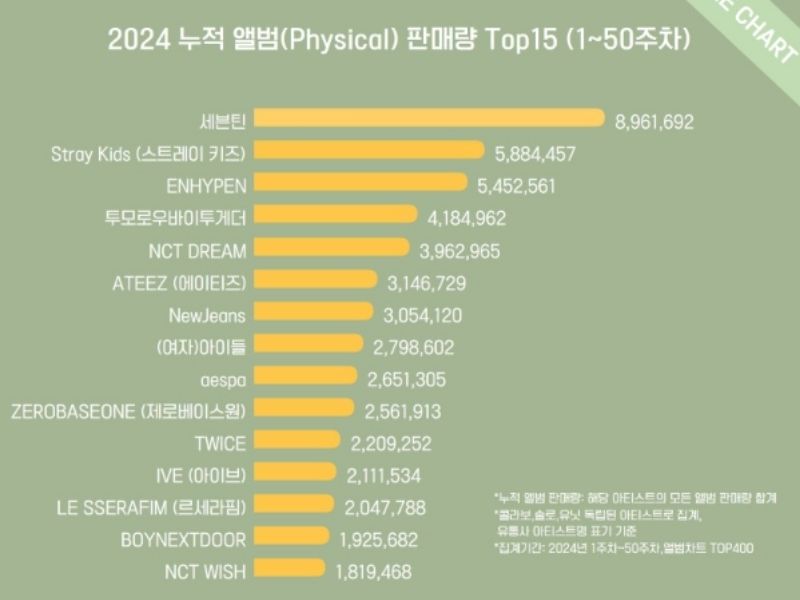
2024 Cumulative Album (Physical) Sales Top 15 (Weeks 1–50) | Circle Chart

Album sales still play a central role in the K-pop business ecosystem. Various entertainment agencies design measured marketing approaches to boost physical album sales, especially during crucial moments after launch.

One of the most common tactics is offering multiple album versions with varying visuals and collection content. Industry studies reveal that K-pop albums typically include bonus items such as photobooks, posters, and random photocards, encouraging fans to purchase multiple copies to expand their personal collection.

Furthermore, random photocards and fan sign coupons are designed to encourage repeat purchases. Many fans are willing to buy dozens of albums at once to obtain photocards of their idol members or simply to increase their chances of attending fan meetings.

Figures from a survey of over 14,000 K-pop fans speak clearly: 36.5% admitted purchasing multiple albums solely to collect photocards, while 27.7% did so to increase their chances of attending fan sign events.

K-pop agencies keep album sales relevant by constantly releasing new variations. The strategy works. Even in a streaming-dominated era, physical albums remain a solid business foundation for the industry.

How the Fandom Economy Drives Album Sales in the Music Industry

However, the first week in the K-pop industry is more than a sales period, as described in the previous section. It has evolved into a uniquely global moment in the music industry. When an album is released, millions of fans around the globe monitor sales charts, which are updated regularly in Korean Standard Time (KST). These numbers fluctuate hourly, creating a competitive dynamic that fans across time zones can simultaneously witness.

A fan in Seoul, Tokyo, Los Angeles, or Paris can view the same charts and watch sales figures rise in real time. This phenomenon makes K-pop first-week sales a global collective experience that unites fans through a common goal: increasing the album sales of the artists they support.

Fandoms often organize various activities to increase album sales, such as:

  • Collective album purchases through group orders.
  • Social media campaigns to support album releases.
  • Global coordination to increase K-pop first-week sales

This active participation makes fandom a key element in maintaining the success of the K-pop industry’s business model.

Conclusion
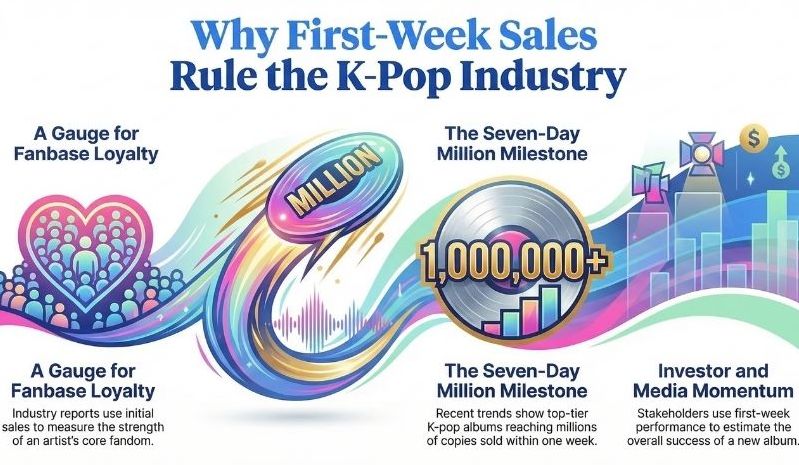
IMAGE - 3 The importance of first-week sales | NotebookLM
IMAGE – 3 The importance of first-week sales | NotebookLM
IMAGE - 3 The importance of first-week sales | NotebookLM
IMAGE – 3 The importance of first-week sales | NotebookLM
IMAGE - 3 The importance of first-week sales | NotebookLM
IMAGE – 3 The importance of first-week sales | NotebookLM

K-pop first-week sales remain a critical early indicator of market success. As the fandom economy shapes the industry, the first week after an album’s release is a defining period for artists and entertainment companies.

Looking ahead, two key trends demonstrate why first-week sales remain relevant in the K-pop business model.

1. First-Week Sales as an Indicator of Fandom Strength

First-week sales are seen as an indicator of fandom strength and are often used to gauge fanbase loyalty.

2. First-Week Sales as an Industry Benchmark

First-week sales have become a main industry benchmark for estimating new album performance. In recent years, some albums have sold millions in just seven days, making first-week figures crucial for entertainment companies, media, and investors.

Therefore, despite an evolving music industry, first-week sales are set to stay central to K-pop’s business model. And as long as the fandom economy remains the primary force driving album sales, the first week of release will remain one of the most defining moments in the K-pop music business cycle.

Join us on Kpoppost’s Instagram, Threads, Facebook, X, Telegram channel, WhatsApp Channel and Discord server for discussions. And follow Kpoppost’s Google News for more Korean entertainment news and updates.



Related Posts

  • K-pop Industry’s Business Strategy for the China Market Amid Cultural Controversies
  • What Is the Lean Startup Model in K-Pop? The tripleS Case Explained
  • Over-Debut: Is K-Pop Sacrificing Artistic Differentiation?
  • From Expansion to Market Saturation: Revenue Fragmentation in the K-Pop Industry
  • The Strategic Rebrand: HYBE America Relaunches BMLG to Blue Highway Records and Names Jake Basden as the New CEO
What's your thoughts?
+1
0
+1
0
+1
0
+1
0
+1
0
+1
0
+1
0
If you like our article and want daily update please join our community
WhatsApp Group Join Now
Telegram Group --> Join Now
Discord Group Join Now
Tags: Album SalesBusinessK-popK-pop Business
ShareTweetShareSendPin
Jae-sung

Jae-sung

A devoted lover of music and art, Jae-sung has discovered a newfound passion for Korean pop music. Through insightful reviews, this creative soul delves into the world of Kpop, sharing their artistic perspective with fellow enthusiasts.

Subscribe
Login
Notify of
guest
guest
0 Comments
Oldest
Newest Most Voted
Inline Feedbacks
View all comments
No Result
View All Result

Recent News

How First Week Sales Became the Key KPI in the Global K-Pop Business Model

How First Week Sales Became the Key KPI in the Global K-Pop Business Model

March 16, 2026
SM Entertainment Group Building

Why SM Entertainment Keeps Returning to House — And Why It Makes Business Sense

March 15, 2026
K-pop Industry’s Business Strategy for the China Market Amid Cultural Controversies

K-pop Industry’s Business Strategy for the China Market Amid Cultural Controversies

March 15, 2026
From Animated Film to Global Franchise: The Business Potential of the “K-Pop Demon Hunters” Sequel

From Animated Film to Global Franchise: The Business Potential of the “K-Pop Demon Hunters” Sequel

March 14, 2026
K-Animation's Profit Model: How “Catch! Teenieping” Powered SAMG Entertainment’s 2025 Turnaround

K-Animation’s Profit Model: How “Catch Teenieping” Powered SAMG Entertainment’s 2025 Turnaround

March 14, 2026
RSS Twitter Instagram Facebook Telegram Github Pinterest Youtube Discord

More from our network

India Tech Desk Korea Tech Desk US Tech Times Korea Travel Post Kpop Post Korea Product Post Korea Game Desk Asia Tech Daily Korea Tech Today

Categories

  • Boy Groups & Singers
  • Events
  • Girl Groups & Singers
  • Interview
  • Kdrama & Kmovie
  • Korean Fashion & Style
  • Kpop New Release
  • Lists
  • News
  • Quiz
  • Rankings
  • Story/Profile
  • Variety Shows
  • 큐피드 편지 – Cupid Letter

FREE NEWSLETTER

Follow Us

  • twitter
  • Telegram

Copyright © 2024 "kpoppost.com" About Us| Terms of Use |Privacy Policy |Cookie Policy Contact : [email protected]

No Result
View All Result
  • 안녕하세요 – About Kpoppost
  • Hot News
    • Boy Groups & Singers
    • Girl Groups & Singers
    • Kpop New Release
    • Kdrama/Kmovie
    • Variety Shows
    • Rankings
  • Interview
  • Events
  • Lists
  • Story/Profile
  • Korean Fashion & Beauty
  • Quiz & Voting
  • Contact Us
  • Subscribe us
  • Login

Copyright © 2024 "kpoppost.com" About Us| Terms of Use |Privacy Policy |Cookie Policy Contact : [email protected]

wpDiscuz
0
0
Would love your thoughts, please comment.x
()
x
| Reply
  • →
  • Contact Us

    Contact Form

  • Telegram
  • WhatsApp
  • Discord