


South Korean television dramas have long illustrated the realities of the country. In March 2026, the new Korean drama “Mad Concrete Dreams” continues this tradition through dark comedy, telling the story of a small-time building owner trapped by the debt he incurs to maintain his property. While exaggerated for entertainment, the story closely reflects common issues in contemporary society.
As reported by The Korea Times, in South Korea, property ownership is widely viewed as a path to financial stability and upward social mobility, prompting many individuals to take significant financial risks. As household debt continues to rise, the series offers a poignant commentary on South Korea’s growing property obsession, revealing how dreams of property ownership are often built on risky, debt-fueled investments.
The “Mad Concrete Dreams” K-Drama and South Korea’s Household Debt Crisis



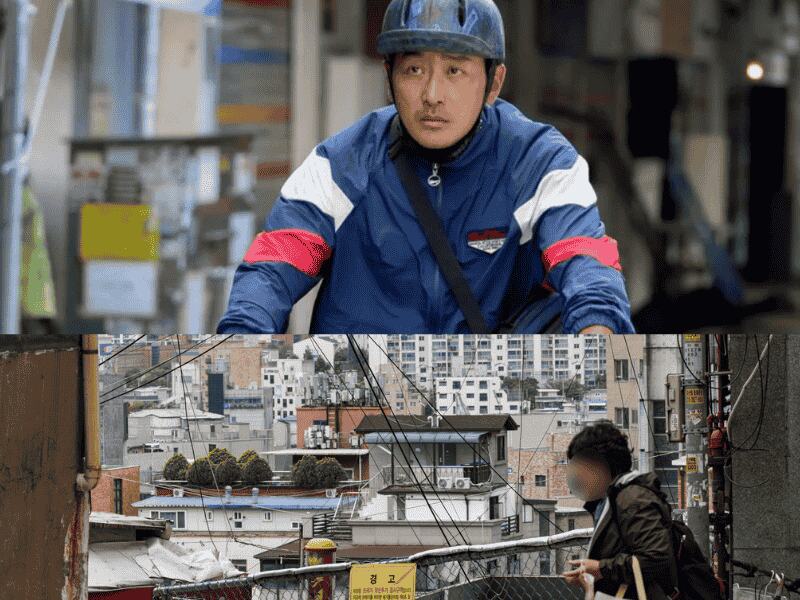
Starring prominent actors like Ha Jung-woo, Lim Soo-jung, Kim Jun-han,. Krystal Jung, and Shim Eun-kyung, the Korean drama “Mad Concrete Dreams” centers on Ki Su-jong (played by Ha Jung-woo). He is a small building owner desperately trying to maintain his property—the only thing he relies on to secure his future. To maintain his investment, he takes out a large loan, only to find himself in a spiral of debt that threatens his finances and his family’s integrity. As the pressure grows, he takes on desperate and risky measures, including staging a fake kidnapping as a way out of the crisis.
Through dark, chaotic comedy, the series explores a harsh reality: when the dream of owning property is built on shaky debt, what initially seems like a path to success can turn into a trap that drags him to the abyss.
How Real Estate Became Central to Property Obsession in South Korea
Real estate has long been the backbone of South Korea’s economic and social life. The country’s rapid economic growth throughout the second half of the 20th century shaped its citizens’ perceptions of property ownership, not just a place to live but also a trusted investment instrument and a marker of social standing.
Ordinary South Koreans have long found property to be their most profitable and affordable investment option for ordinary people. Before financial markets developed, they had few alternatives. The Korea Stock Exchange only began developing in the 1980s, and even then people view it as a risky arena. At that time, investors overly focused on the shares of specific companies, a strategy that led to losses. It’s no wonder that many equate the stock market with gambling rather than true investment.
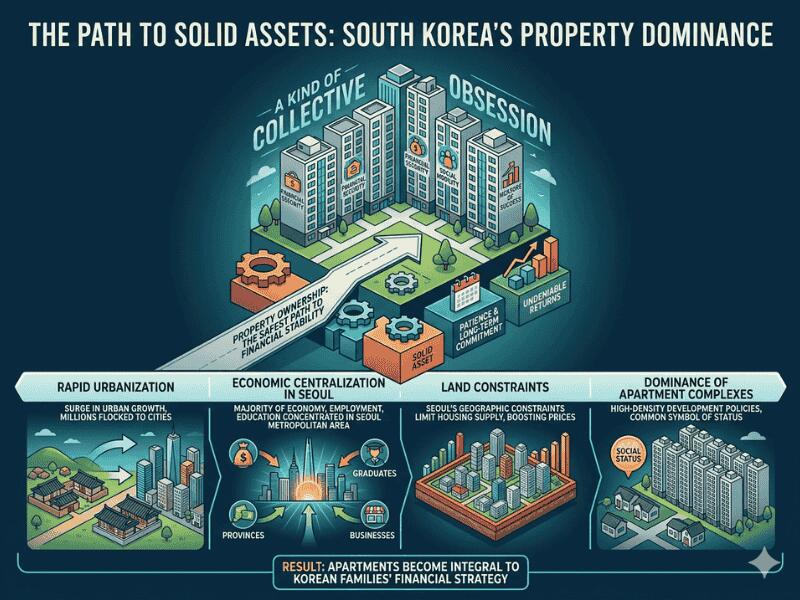
In contrast, property was seen as a much more solid asset. It required patience and long-term commitment, but the returns were believed to be undeniable. Gradually, this belief took root, solidifying property ownership as the safest path to financial stability. As a result, housing, especially apartments in major cities, has become an integral part of the financial strategy of most Korean families.
Structural Factors Driving Dominance in Property Investment
Several structural factors have contributed to the dominance of this property investment:
- Rapid urbanization — South Korea experienced a tremendous surge in urban growth during its industrialization, as millions of people flocked from rural areas to seek a living in the cities.
- Economic centralization in Seoul — The majority of the economy, employment, and educational institutions are concentrated in the Seoul metropolitan area, which has dramatically boosted housing demand in the capital city.
- Land constraints — Seoul’s tight geographic constraints have limited housing supply, contributing to the continued rise in property prices.
- The dominance of apartment complexes — Urban housing policies that prioritize high-density apartment development have ultimately made this housing model the most common and recognized symbol of social status.
This combination of economic, institutional, and cultural factors has ultimately elevated property far beyond its basic function as a place to live. Apartments in Seoul, in particular, have become a symbol of financial security, a ladder to social mobility, and a measure of success in life. Property ownership has slowly become a kind of collective obsession in South Korean society.
Rising Household Debt Behind Korea’s Real Estate Boom
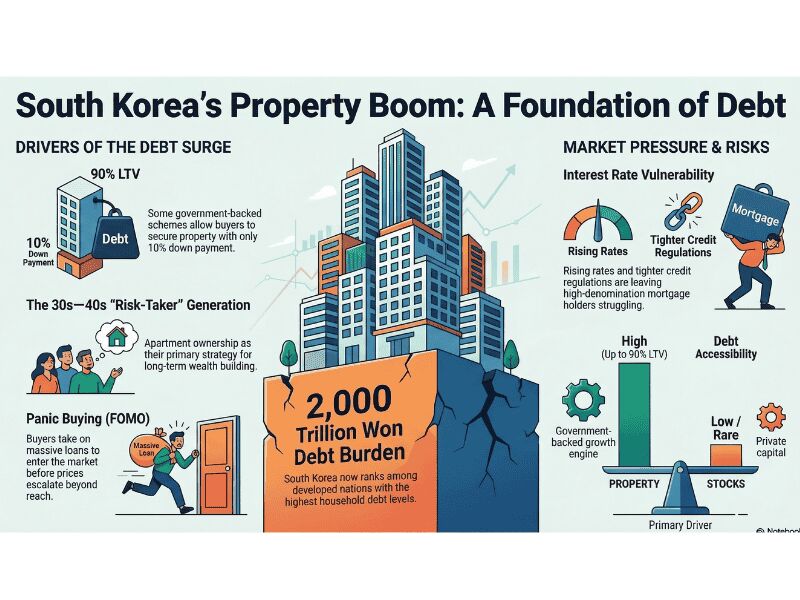
The property boom in South Korea is also linked to an equally massive expansion of household debt. Many families are boldly jumping into the property market with substantial borrowing capital, particularly through home ownership loans. According to Seoul Economy Daily, Bank of Korea data shows that South Korea’s household debt is approaching 2,000 trillion won. That level places South Korea among the developed nations with the highest household debt burdens, with the majority of this debt stemming from property purchases.
Several factors explain why this phenomenon has grown so significantly:
1. Buying Style with Large Debt
Many property buyers in South Korea rely on large loans to enter the market. Continuously rising property prices, especially in Seoul, make many feel compelled to buy quickly before prices escalate beyond their reach. As a result, many households are taking on large debts to secure apartments or small properties, betting that their values will continue to rise.
2. A Financial System Facilitates Large Loans
Unlike stock investments, which are rarely supported by bank loans, property investments are supported by a broader credit ecosystem. The South Korean government, over various periods, has tended to promote the property sector as an engine of economic growth.
One reflection of this is the Loan-to-Value (LTV) ratio, which in some cases can reach 90%, meaning that with just 10% of the house price as capital, someone can obtain a loan for the remainder. This convenience does open wider access to the property market, but it also deepens household dependence on debt.
3. A Productive Generation Daring to Take Big Risks
The buyers who most frequently take advantage of this scheme are generally in their 30s and 40s. They are willing to take on installments with a significant portion of their debt, hoping that rising property prices will eventually yield a commensurate return. For many in this age range, owning an apartment is not simply a place to live, but a primary strategy for building wealth.
4. Interest Rates Rise, Pressure Comes
However, heavy reliance on debt carries risks that cannot be ignored. As credit regulations tighten and interest rates begin to creep up, many high-denomination mortgage holders are feeling the pressure. The ballooning installments have left some households struggling to meet their payment obligations.
What the “Mad Concrete Dreams” K-Drama Says About Korea’s Household Debt
The Korean drama “Mad Concrete Dreams” ultimately highlights the consequences of pursuing wealth through debt-financed property. Through Ki Su-jong’s struggles, the story reveals how the dream of property ownership can trap individuals between ambition and financial reality. The story reflects South Korea’s growing obsession with property, where owning a building or apartment is often seen as a path to financial security. By depicting the pressures and risks behind such choices, the series resonates with current concerns about rising household debt. In the end, it reminds viewers that pursuing property can have financial consequences.
Join us on Kpoppost’s Instagram, Threads, Facebook, X, Telegram channel, WhatsApp Channel and Discord server for discussions. And follow Kpoppost’s Google News for more Korean entertainment news and updates.