

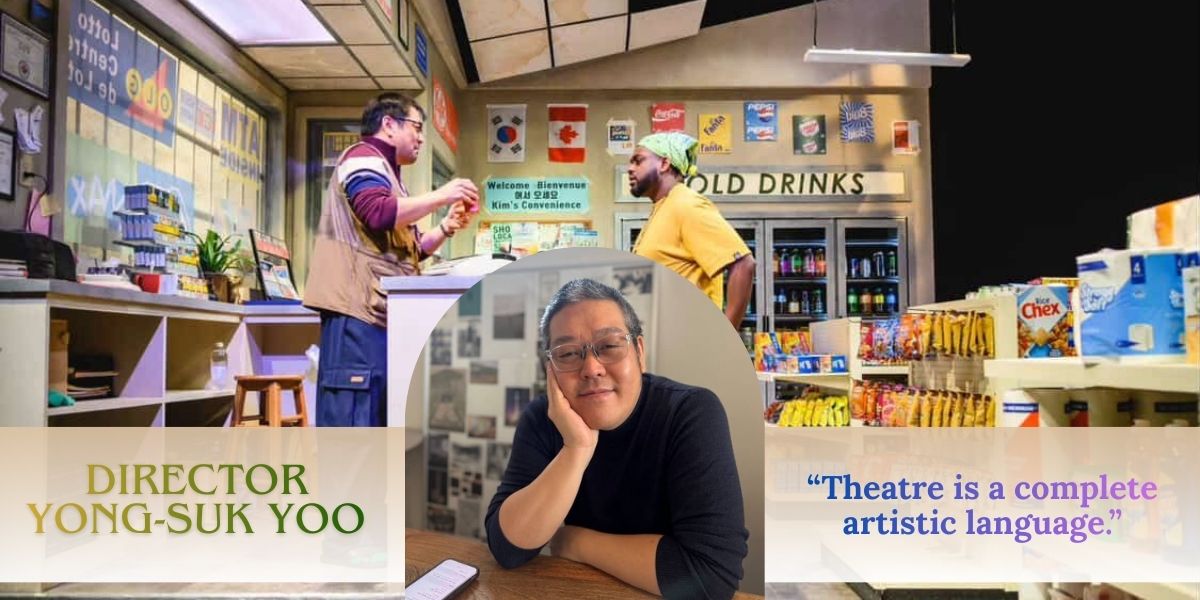
Originally written by Ins Choi, “Kim’s Convenience” began its life on stage long before it became a global television phenomenon. While the TV adaptation introduced the story to a wider audience, the theatre version remains the work’s emotional and ideological foundation.
Directed by Yong-suk Yoo, this stage production returns to the play’s original core: a Korean immigrant family navigating survival, change, and intimacy within a rapidly shifting urban landscape. Set against the backdrop of gentrifying Toronto, the story captures moments of friction and tenderness that feel deeply personal yet widely recognizable.
What makes “Kim’s Convenience” endure is not its cultural specificity alone, but its emotional accuracy. The play speaks to anyone who has lived between generations, languages, or expectations. It resonates with American audiences not because it explains immigrant life, but because it reflects family life as it is lived—messy, humorous, stubborn, and deeply loving.
An Interview with Director Yong-suk Yoo of “Kim’s Convenience”



In the conversation below, Yoo reflects on realism versus adaptation, comedy rooted in sincerity, identity beyond borders, and why theatre remains a complete artistic language in itself.
Why the Stage Version Matters
When asked why returning to the play is significant, Yoo said:
“Compared to the TV series, which felt somewhat sugar-coated, the stage version allows me to engage with the lived reality of a Korean immigrant family. My goal was to balance documentary-informed perspective with emotional empathy and compassion.”
While the television adaptation expanded roles—especially for female characters—Yoo’s production emphasizes warmth, humor, and realism. It also highlights Toronto’s socio-cultural context during the time Choi wrote the play.
“The stage production I directed aimed to preserve the warmth and humor inherent in the original work while approaching the material through a more objective lens. I was interested in re-engaging with the context of Toronto’s gentrification at the time Ins Choi wrote the play, and with the lived reality of a Korean immigrant family attempting to survive and adapt within that environment.”
Themes That Resonate Beyond the Korean Community

What makes Kim’s Convenience enduring isn’t only its cultural specificity, but its emotional accuracy. Yoo explained:
“Beyond the keyword of ‘immigrant family life,’ the play engages with themes like familial love, generational conflict, and intercultural coexistence. These create multiple points of connection with American audiences, allowing the characters and experiences to resonate beyond the Asian community.”
The play’s stories of love, compromise, and identity feel familiar to anyone who has navigated complex family or cultural dynamics.
“These themes create multiple points of connection with American audiences, allowing the characters and their experiences to resonate across different cultural and social backgrounds.”
Guiding the Actors: Empathy Over Prescription
Yoo approaches directing with collaboration rather than strict guidance.
“I do not recall giving the actors particularly prescriptive direction. We spent a lot of time discussing each situation, developing empathy for the choices Appa and Umma make. Song Kim, who played Appa, had a father who ran a convenience store. Saja, playing Umma, brought her own experiences as a mother and even a Korean-style rice cooker to rehearsal. They were already ready.”
This approach allows actors to inhabit their characters authentically, generating humor and emotional depth organically.
“There was very little I needed to do as a director. They were already ready.”
What Does Kim’s Convenience Say About the American Experience Today?

oo does not approach theatre with a predetermined message. He does not direct with the intention of making a political statement or delivering a clear-cut thesis.
But when asked what the play ultimately expresses, he distilled it into one line:
“We have endured, we are enduring, and we will continue to endure.”
According to Yoo, this sentiment reflects more than just the American experience. It speaks to diasporic communities more broadly—families who build lives across borders, languages, and systems that were not originally built for them.
Importantly, Kim’s Convenience does not frame immigrant life as pure sacrifice or tragedy. It acknowledges hardship, but it also recognizes romance, humor, and small daily victories. The play presents endurance not as suffering alone, but as persistence layered with love, stubbornness, and laughter.
In that sense, the story feels distinctly American—and at the same time, universally human.
Comedy Without Stereotypes
Yoo believes that humor emerges from sincerity.
“Comedy happens when characters engage fully with their circumstances. Immigrants’ sensitivity to social and cultural contexts creates natural humor without resorting to stereotypes.”
This perspective ensures the play’s comedy resonates universally, avoiding caricature while remaining emotionally truthful.
“Immigrants tend to be far more sensitive to the linguistic, social, and cultural contexts in which they are situated. Allowing characters to respond with what might appear as excessive sensitivity and earnestness made it possible to generate humor and emotional depth simultaneously.”
Reflections on Identity

Directing the play also shaped Yoo’s personal understanding of identity:
“A genuinely diasporic Korean perspective isn’t confined to a single identity. I now comfortably refer to myself as Korean American. ‘Korea’ is no longer just a matter of citizenship or territory.”
Through the play, Yoo explored the fluidity of identity, reflecting the experiences of many diasporic communities.
“I now comfortably refer to myself as Korean American. While my official nationality remains South Korean, ‘Korea’ for me is no longer merely a matter of citizenship or territory. This realization is one of the most meaningful personal insights I gained through directing this production.”
Theatre as a Complete Artistic Language
Yoo challenges the idea that theatre is a stepping stone to film or television:
“Theatre is a complete artistic language. It allows stories to exist truthfully without needing polish or adaptation for screens.”
For Yoo, the stage offers a space where audiences can engage deeply with characters, narratives, and cultural context in ways unique to live performance.
What Emotional Response Did Yoo Want From the Audience?

From the very first reading, Yoo set a clear emotional goal for the cast.
“I told the actors, ‘I want to make the audience laugh and cry.’ Personally, I think that is precisely what life is like.”
For Yoo, the emotional rhythm of Kim’s Convenience mirrors everyday life. Humor and grief do not exist separately. They overlap. A joke can land in the middle of tension. A tender moment can arrive right after conflict.
Rather than pushing the audience toward a single reaction, Yoo wanted them to experience both—laughter and tears in the same breath. That duality, he suggests, is what makes the story feel honest.
Lessons for American Theatre and Beyond
Kim’s Convenience demonstrates the power of sincere storytelling:
“I do not feel that this is a question I am fully qualified to answer.
When creators focus on showing what needs to be told, success can emerge. The industry can learn to value meaningful stories over immediate profits.”
The play’s strength lies in its emotional resonance and authenticity, creating connections across cultural boundaries.
“From a long-term perspective, it is more important to study where values and meaning are flowing, rather than focusing solely on where money is flowing.”
Is Theatre Just a Stepping Stone to Film or Television?

Yoo rejects that idea outright.
“Theatre is not a preliminary form but a complete artistic language in itself.”
For him, the stage is not a testing ground for screen adaptation. It is a fully realized medium with its own grammar, intimacy, and immediacy. Theatre does not need validation from film or television to prove its relevance.
He adds:
“We can only live within the world to the extent that we believe in it. In that sense, it ultimately does not matter what anyone says about it.”
In other words, theatre’s power depends on collective belief—between actors and audience, in real time. That shared presence is not a lesser version of storytelling. It is its own form of truth.
What Does Yoo Hope Kim’s Convenience Contributes to American Theatre?
Yoo sees art at its strongest when it does more than reflect what already exists.
“Art reveals its true value not when it reinforces dominant perspectives, but when it generates productive tension against existing structures and proposes healthy alternatives.”
For him, the contribution of Kim’s Convenience is not simply representation. It is expansion. Expansion of whose stories are centered. Expansion of who gets to define the emotional core of American theatre.
He adds:
“I hope American audiences will increasingly have the opportunity to experience the joy of being fully captivated by the immense and boundless potential of Asian artists.”
In practical terms, that means moving beyond token inclusion. It means allowing Asian artists to shape narratives, aesthetics, and emotional landscapes at the center—not the margins—of the stage.
The Feelings that Stays at “Kim’s Convenience”
What stays with you after “Kim’s Convenience” is not a lesson, a message, or a political statement.
It is a feeling.
A recognition of parents who tried their best with limited tools.
Of children caught between gratitude and resentment.
Of lives shaped by endurance, but never reduced to it.
Yong-suk Yoo’s approach reminds us why theatre still matters. Not as a stepping stone. Not as a softer version of screen storytelling. But as a space where truth can exist without polish, where humor comes from sincerity, and where identity is allowed to remain fluid.
This is why “Kim’s Convenience” continues to speak to American and global audiences beyond labels and lineage. It does not ask to be understood as an “immigrant story.”
It simply asks to be seen as a human one.
And in that space—between laughter and tears—it quietly proves that some stories do not need to be translated to be felt.
Join us on Kpoppost’s Instagram, Threads, Facebook, X, Telegram channel, WhatsApp Channel and Discord server for discussions. And follow Kpoppost’s Google News for more Korean entertainment news and updates.