
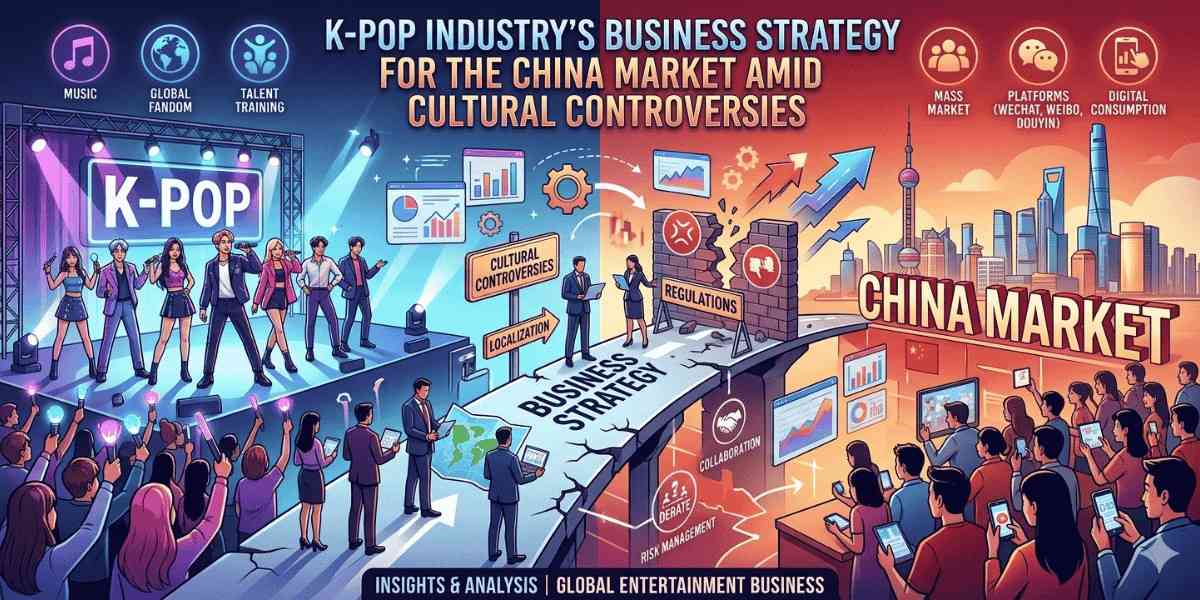
The K-pop industry continues to strengthen its grip on the international stage, with the Chinese market remaining one of the most important expansion destinations for Korean entertainment companies. This situation persists despite relations between Seoul and Beijing often being marred by cultural friction and political tensions.
The difficult period began when the Chinese government imposed unofficial restrictions on Korean artists following the Terminal High Altitude Air Defense (THAAD) system decision in 2017. Since then, the Korean entertainment industry’s efforts to export to the Chinese market have been rocky. Despite this, public interest in K-pop content shows no significant signs of waning.
Album sales figures, vibrant online fan communities, and high consumption of Korean entertainment content are evidence that K-pop’s allure in this market remains strong. In response to these challenges, several Korean entertainment companies have begun to redesign their business strategies. Read on for this explanation until the end.
K-pop Industry Growth in the Chinese Market Faces Cultural and Political Challenges
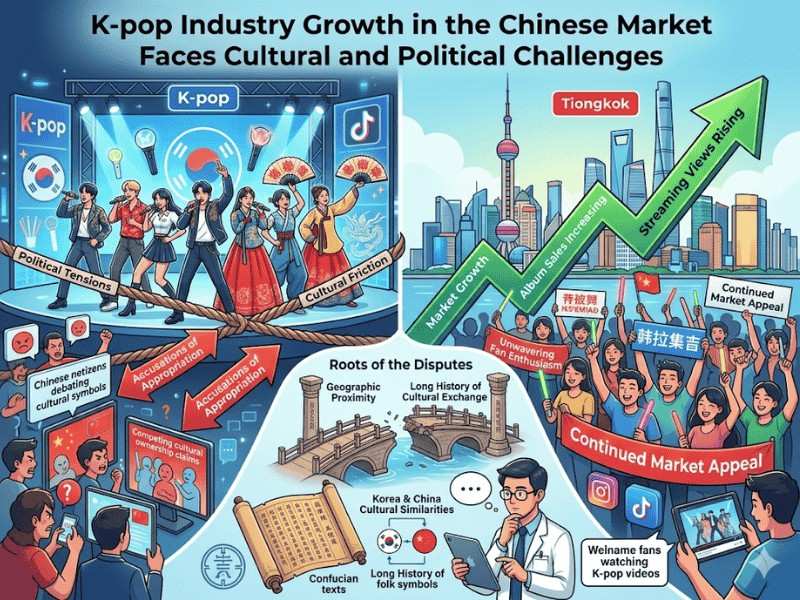
Cultural friction often arises whenever Korean groups incorporate traditional East Asian elements into their stage performances or fashion choices. In digital spaces, Chinese netizens actively debate claims to certain symbols, whether related to traditional clothing patterns or mythological figures, which some consider closer to Chinese ancestral heritage than Korean.
These debates are merely the surface of a much deeper issue: competing claims to cultural ownership that have long simmered in East Asia.
Researchers have also highlighted that cultural proximity is one of the roots of such disputes. Korea and China’s geographic proximity, coupled with a long history of cultural exchange between the two, including in Confucian traditions and folk customs, makes K-pop products more susceptible to triggering negative reactions. When K-pop content deliberately incorporates historical and traditional elements, Chinese netizens often accuse Korea of borrowing or even appropriating their cultural heritage.
Despite these issues, Chinese audiences’ interest in K-pop appears to have remained unwavering. The industry continues to maintain its appeal, as if the constant controversies are not enough to dampen fans’ enthusiasm.
K-pop Exports Continue to Strengthen the China Market Presence
Recent political signals indicate a significant thaw in relations between the two countries. China opened its doors to Korean tourists visa-free starting in November 2024, and Korea responded by announcing a temporary visa waiver for Chinese tourist groups, scheduled to take effect in the third quarter of this year.
This positive trend is also reflected in K-pop export figures. Data from the Korean Customs Service shows a significant recovery: after album exports to China plummeted from US$51.3 million in 2022 to US$33.9 million in 2023, they surged to US$59.8 million throughout 2024.
The momentum intensified in early 2025. In the first quarter alone, China became Korea’s largest album export market, with shipments reaching US$12.96 million, surpassing Japan, Taiwan, and the United States combined.
In fact, the Chinese government announced its commitment in early 2026 to gradually revive cultural content exchanges with Korea, including films and television dramas. This move is a sign of improving cultural relations between the two countries, which had been frozen in recent years.
K-pop Business Strategy Adapts to Regional Sensitivities
In response to shifting cultural and political dynamics in the Chinese market, Korean entertainment companies are beginning to adopt more adaptive business strategies.
1. Collaborating With Local Companies

One approach Korean entertainment companies have taken to adapt to the Chinese market is to establish strategic partnerships with local entertainment and technology industry players. This type of collaboration helps Korean agencies better understand the domestic regulatory landscape, local audience preferences, and content distribution mechanisms across various Chinese platforms.
A concrete step in this direction is evident in Tencent Music Entertainment’s entry into SM Entertainment, a Chinese technology giant. The company acquired approximately 2.2 million SM shares from HYBE for 243 billion won, equivalent to approximately US$177 million. With a 9.7 percent stake, Tencent Music is now the second-largest shareholder in SM Entertainment, just behind Kakao Corp. and Kakao Entertainment.
This investment is seen as a reflection of the increasingly close relationship between the Korean entertainment industry and the Chinese media, while opening new channels for the broader distribution of K-pop and Korean entertainment content in the Chinese market.
2. Using Chinese Social Media Platforms
Another widely implemented strategy is optimizing digital marketing through platforms already well-established among Chinese users, such as Weibo and Douyin. Rather than relying on international channels, which often have limited access, Korean agencies actively use local social media to promote their artists. This way, K-pop content can still reach Chinese audiences effectively, even though some global platforms are not freely accessible there.
3. Forming Groups and Sub-units Targeting the China Market
Several Korean entertainment companies have also adopted a more direct approach, forming groups or sub-units specifically designed to target the Chinese market. This approach typically involves recruiting members from outside Korea, or idols fluent in Mandarin, to build a more organic connection with local audiences.
SM Entertainment is one of the most prominent examples of this. The company launched WayV, a unit of the boy band NCT, entirely focused on the Chinese market and using Mandarin as the primary language in its music and content. SM Entertainment had already taken a similar approach in the early 2010s, when it formed the sub-unit EXO-M to reach its China fan base.
Why the China Market Remains Critical for the K-pop Industry
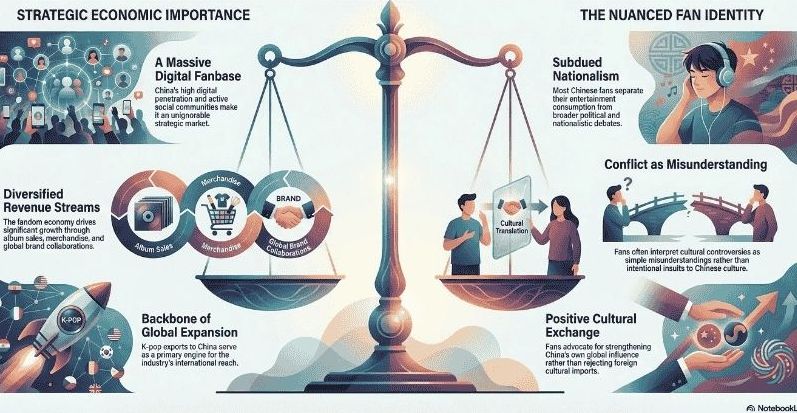
Amidst the turmoil of cultural controversies and the ebb and flow of political relations, China remains one of the most strategic markets for the K-pop industry. Its massive population, high digital penetration, and vibrant, active fan communities across various social media platforms make the Chinese market too valuable for the Korean entertainment industry to ignore.
On the other hand, the growth of the K-pop fandom economy has also created a variety of new business opportunities, from album and merchandise sales to collaborations with global brands, further solidifying K-pop exports as a backbone of Korean entertainment’s expansion onto the international stage.
Interestingly, however, the dynamics of Korea-China cultural relations have also shaped how fans perceive K-pop. A study found that most K-pop fans in China tend to express a more subdued form of nationalism in online debates about culture and identity.
The study’s findings reveal several important patterns:
- Many fans try to balance their Chinese national identity with their love of K-pop.
- Some fans view cultural controversies involving K-pop idols as misunderstandings, rather than intentional insults to Chinese culture.
- Some also emphasize that cultural exchange between Korea and China can have a positive impact on both countries.
- Some fans argue that rather than rejecting K-pop, China should strengthen its own cultural influence on the global stage.
This reflects a complex reality: while issues of nationalism and cultural identity have never been completely absent from the public sphere, many K-pop fans in China can separate their entertainment consumption from the broader political fray.
Final Insights
The China market appears set to remain a priority in the K-pop industry’s global expansion plan. Its large fan base, combined with the economic potential inherent in fandom communities, makes China a crucial market for Korean entertainment’s growth, despite ongoing challenges posed by political and cultural sensitivities.
From a business perspective, Korean entertainment companies are expected to refine their strategies further to be more flexible and responsive to local conditions. Strengthening partnerships with local business partners will likely be a key pillar of their future approach, all geared toward maintaining the sustainability of K-pop exports while expanding distribution reach in international markets.
Join us on Kpoppost’s Instagram, Threads, Facebook, X, Telegram channel, WhatsApp Channel and Discord server for discussions. And follow Kpoppost’s Google News for more Korean entertainment news and updates.