


In early 2026, a localized fan dispute escalated into a region-wide digital conflict now referred to as the “Knetz vs SEAblings” friction.
While the financial damage remains limited as of Q1 2026, the episode reveals structural vulnerabilities in the Hallyu export model—particularly its heavy dependence on Southeast Asia’s digitally unified consumer base.
What Is the Knetz vs SEAblings Conflict?
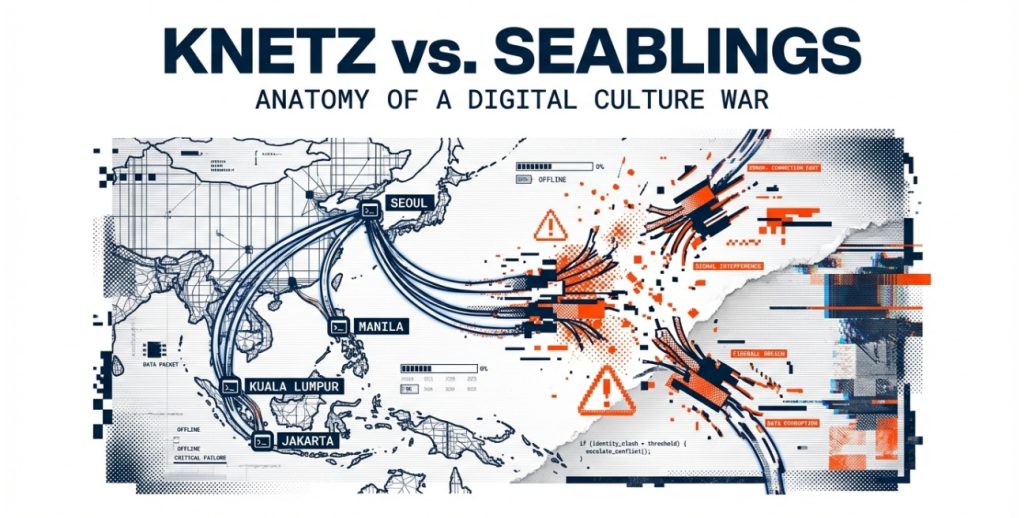
The “Knetz vs SEAblings” conflict refers to an online escalation between South Korean netizens (“Knetz”) and Southeast Asian digital communities (“SEAblings”) following a controversy at a Axiata Arena concert event.
The dispute evolved from venue protocol violations into a broader narrative involving racism, privacy norms, and cultural hegemony—ultimately mobilizing a cross-border ASEAN digital alliance.
Knetz vs SEAblings Chronological Timeline of Escalation (January–February 2026)
January 31, 2026 – Trigger Event
- Incident at a Day6 concert held at Axiata Arena.
- Korean fansite masters allegedly used professional DSLR telephoto lenses in violation of venue regulations.
- Identity of a fansite master was circulated online without anonymization.
- Knetz framed this as a violation of Korean privacy norms.
- Local fans prioritized venue compliance and public accountability.
Impact: Initial bilateral friction (Korea–Malaysia).
February 8, 2026 – Algorithmic Amplification
- Google Trends shows spike in searches for “Knetz” and “SEAblings.”
- First boycott calls appear via X (Twitter), notably from bot account @St*rf**s.
- Post reaches ~961,000 views.
Risk Classification: Coordinated Inauthentic Behavior (CIB).
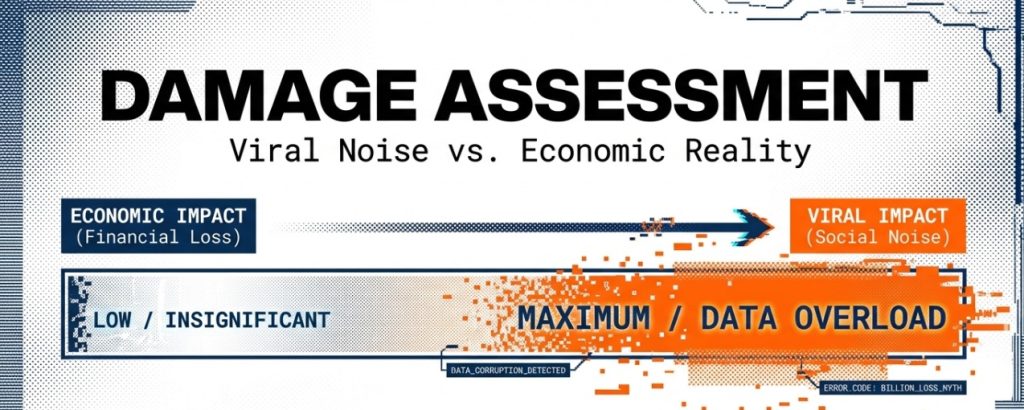
Economic Reality: No verified financial losses.
February 13–18, 2026 – Racism Narrative Escalation
- Knetz criticize Indonesian girl group No Na.
- A music video filmed in a rice field becomes subject to poverty-related mockery.
- “Rice field” insult becomes viral flashpoint.
Outcome:
Formation of “SEAblings”—a cross-ASEAN solidarity front (Indonesia, Malaysia, Philippines, Thailand, Vietnam).
February 19, 2026 – Media Investigation
- Metro TV investigates economic claims.
- Reporting indicates:
- No official boycott structures
- No formal petitions
- No confirmed sales collapse
Conclusion:
Digital intensity ≠ measurable macroeconomic disruption.
Why ASEAN Is a Strategic Vulnerability for Hallyu
ASEAN Hallyu Market Size (2023 Data)
As of 2023, the Hallyu fan base across the ASEAN region totaled approximately 40.44 million members, underscoring Southeast Asia’s role as one of the most strategically important overseas markets for Korean cultural exports. Within this regional bloc, Thailand alone accounted for more than 19 million members, making it the single largest Hallyu market in Southeast Asia and a critical concentration point for consumer sentiment and revenue exposure.
Unlike fragmented markets elsewhere, ASEAN demonstrates:
- High cross-border digital contagion
- Strong cultural solidarity
- Collective mobilization capacity
Market Concentration Risk
While China remains larger in absolute revenue potential, Southeast Asia presents higher sentiment contagion velocity.
If trust collapses across ASEA, it means up to 40+ million consumers could shift simultaneously. Moreover, the damage would be reputational before financial—but structural in nature.
Consumer Behavior Shift: The “Local Pride” Pivot
The most important development is not boycott rhetoric—it is identity formation.
Protective Solidarities
Historically competitive ASEAN fan communities temporarily unified under “SEAblings.”
This marks:
- Digital sovereignty assertion
- Collective defense against perceived cultural condescension
Linguistic Defense Mechanisms
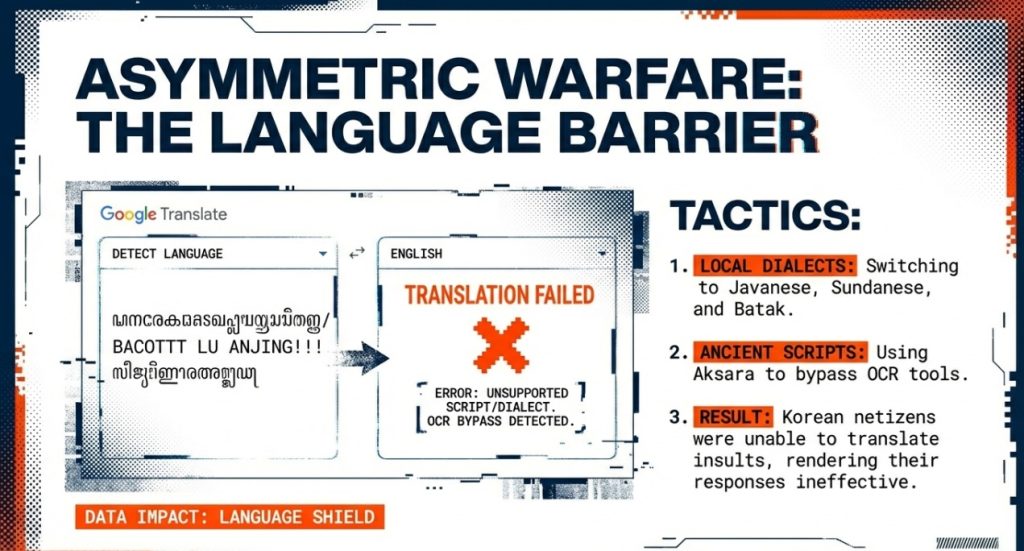
To bypass automated translation and exclude Korean netizens, Indonesian netizens use local languages, including Javanese dialects and scripts, Sundanese dialects and scripts, Batak dialects, and more.
This reduces cross-market transparency and complicates sentiment monitoring for Korean stakeholders.
Cross-Market Contagion: Indian Alignment
Knetz confusion between “Indo” (India) and ”Inni” (Indonesia in Korean context). As a result Indian netizens join SEAblings discourse. In this case, the conflict expands into adjacent populous markets.
This demonstrates how digital friction can unintentionally mobilize secondary geographies.
Promotion of Regional Alternatives
Furthermore, Indonesian netizens take this chance to elevate their local artists. The artists elevated during the conflict including Feby Putri, Lyodra, and Baskara Mahendra. These figures became symbolic of the “Local Pride” narrative.
This is not anti-K-pop (yet)—it is pro-regional identity positioning.
Financial Claims vs. Verified Data
During the peak of the Knetz vs SEAblings conflict, viral social media posts claimed that Korean entertainment companies were suffering “billions in losses” due to a successful regional boycott across Southeast Asia. These claims spread rapidly across X and TikTok, creating the perception of a large-scale economic backlash against Korean cultural exports.
However, as of February 2026, there is no verified evidence supporting those claims. There have been no officially organized or institutionally coordinated boycott movements, no public investor disclosures reporting financial damage linked to the conflict. Additionally, no independent media or financial audits confirming significant revenue losses.
Further investigation shows that many of the viral loss narratives originated from bot-amplified accounts, unverified TikTok commentary, and emotionally reactive posts rather than documented financial data. In other words, the scale of the online narrative was far greater than the measurable economic impact.
That said, while the financial damage remains unproven, the reputational signal should not be dismissed. Even without immediate revenue loss, sustained negative sentiment can gradually influence brand perception, consumer trust, and long-term market positioning in Southeast Asia.
Investment & Strategic Risk Analysis
From an investment and strategic risk perspective, the Knetz vs SEAblings conflict exposes vulnerabilities that extend beyond short-term digital controversy. While immediate financial losses remain unverified, the longer-term reputational and structural implications deserve closer scrutiny.
Reputational Time Bomb
First, there is a potential reputational time bomb.
During the height of the conflict, online discussions began referencing concerns raised in May 2025 by the UN Human Rights Committee regarding xenophobia and the treatment of migrant workers in South Korea.
It is important to emphasize that no formal institutional link has been established between this specific netizen dispute and systemic discrimination issues. However, the narrative convergence itself creates risk.
If public discourse were to connect entertainment-sector behavior with broader human rights concerns, Korean companies operating in ASEAN could face heightened ESG scrutiny, increased regulatory attention, and reputational repositioning challenges in key Southeast Asian markets.
Cultural Hegemony Risk
Second, the perception of “cultural arrogance” introduces a more subtle but potentially structural risk.
When consumers begin to interpret cultural exports as symbols of condescension rather than aspirational lifestyle products, sentiment can evolve into what functions as a psychological non-tariff barrier.
This would not take the form of formal trade restrictions but rather soft resistance: brand rejection extending beyond K-pop into adjacent Korean exports such as beauty products, food brands, and even technology services.
Hallyu operates as a soft-power halo. If the halo cracks, adjacent industries may experience demand elasticity shifts.
Long-Term Investment Implications
Third, while the short-term financial impact remains limited to digital volatility and online narrative amplification, the medium- to long-term investment implications are more consequential.
The conflict has accelerated signs of consumer nationalism within ASEAN, encouraged the growth and promotion of regional entertainment ecosystems, and potentially weakened the cultural premium historically enjoyed by Korean exports.
The key inflection point is identity consolidation. SEAblings marks the first cohesive ASEAN digital cultural bloc opposing perceived Korean hegemony.
Business POV: What Korean Stakeholders Must Monitor
In practical terms, the current episode may NOT YET represent a revenue crisis. However, it signals a structural shift in market psychology. For Korean investors and companies with high exposure to Southeast Asia, the core risk is not immediate loss. It is the gradual rebalancing of cultural influence and consumer loyalty across a region representing more than 40 million engaged Hallyu fans.
Therefore, here are things that Korean stakeholders must keep their eyes on:
- Sentiment trendlines in Indonesia and Thailand (largest fan bases)
- Growth trajectory of regional artists vs. K-pop consumption rates
- ESG narrative overlap with racism discourse
- Government cultural diplomacy response
- Platform moderation enforcement on cross-border hate speech
Conclusion: Knetz vs SEAblings Impact
We can conclude that as of February 2026, the Knetz vs SEAblings conflict is digitally loud, economically limited, and strategically significant.
It signals a structural shift:
Southeast Asia is no longer a passive consumer base—it is an identity-driven digital bloc capable of synchronized sentiment shifts.
For investors in Korean entertainment and consumer exports, the core risk is not immediate revenue loss. It is the gradual emergence of consumer nationalism in ASEAN—a force that could permanently reshape the competitive landscape of Hallyu across the region.
Join us on Kpoppost’s Instagram, Threads, Facebook, X, Telegram channel, WhatsApp Channel and Discord server for discussions. And follow Kpoppost’s Google News for more Korean entertainment news and updates.