


Can someone who wasn’t there still claim what you left behind? That question turned into a national debate after the late Kpop star Goo Hara’s inheritance dispute came into the spotlight. Now, the question is at the center of South Korea’s “Goo Hara Law,” a new inheritance rule that takes effect on January 1, 2026. This isn’t only about a legal update. It’s a cultural moment about responsibility, family, and fairness.
Korea’s Goo Hara Law Starts in 2026—Here’s What Changes

For years, a biological tie could keep an absent parent in the inheritance line, even when care and support were missing.
Now, the rules have changed. The “Goo Hara Law” finally takes effect on January 1, 2026. In severe cases of negligence or misconduct, the family can take legal action to revoke the offender’s inheritance rights.
This isn’t about revenge. It’s about responsibility.
In Goo Hara’s case, one question hits hard. When parenthood comes with duties. So should inheritance come with accountability?
The Case That Made the Public Listen

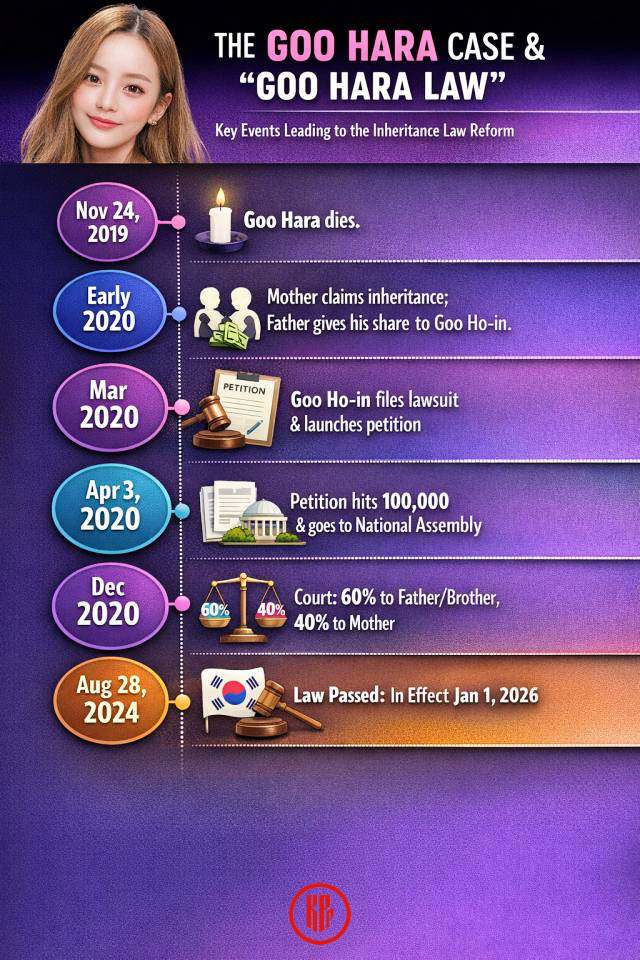
Goo Hara (from the Kpop group KARA) died on November 24, 2019.
At a 2020 press conference, Goo Ho-in said his estrangedmother appeared at the funeral and tried to take charge. He said, she recorded conversations and took selfies with celebrities who came to pay their respects.
Soon after, Goo Hara’s family inheritance dispute became public. Her biological mother—who had been absent since she was nine—returned and tried to claim a share of her estate.
Why could she claim the inheritance?
Under Korea’s default inheritance rules, if someone dies with no spouse and no children, the next heirs are their parents. And under the old system, before the Goo Hara Law took effect, it included parents who had been absent for years. Therefore, she had a legal path to claim Goo Hara’s inheritance.
In March 2020, Goo Ho-in spoke publicly and filed a lawsuit against their mother over the inheritance division. Around the same time, he launched a public petition calling for a change to Korea’s inheritance law—often called the “Goo Hara Act.”
He urged lawmakers to make sure her death was “not in vain.” The petition reached 100,000 signatures and was submitted to the National Assembly in April 2020.
In December 2020, the Gwangju Family Court recognized the family’s “contributory portion.” Splitting Goo Hara’s inheritance: 60% to her father as the primary caregiver, and 40% to her mother.
Goo Hara’s father then transferred his part to Goo Ho-in, her brother.
For many people, the outcome still felt like a loophole. The question wasn’t only about percentages, but whether abandonment should come with consequences.
The public pressure continued.
In 2024, Korea’s National Assembly passed a revision tied to what people call the “Goo Hara Law,” and Goo Hara’s brother publicly reacted to the news. In his press conference, he expressed his hope that no more families will have to endure the pain his family went through.
What the New Law Allows (Civil Act Article 1004-2)
The “Goo Hara Law” is linked to Civil Act Article 1004-2. It created a system where a court can declare the loss of inheritance rights. This applies to direct ascendants, such as parents.
A court may revoke inheritance rights if a parent seriously neglected their duty of support while the child was a minor.
It can also apply if the parent committed a serious crime against the deceased, the deceased’s spouse, or the deceased’s lineal descendants.
In short, in severe cases, the law can move from “smaller share” to “no share.”
A New Path, But Not An Easy One
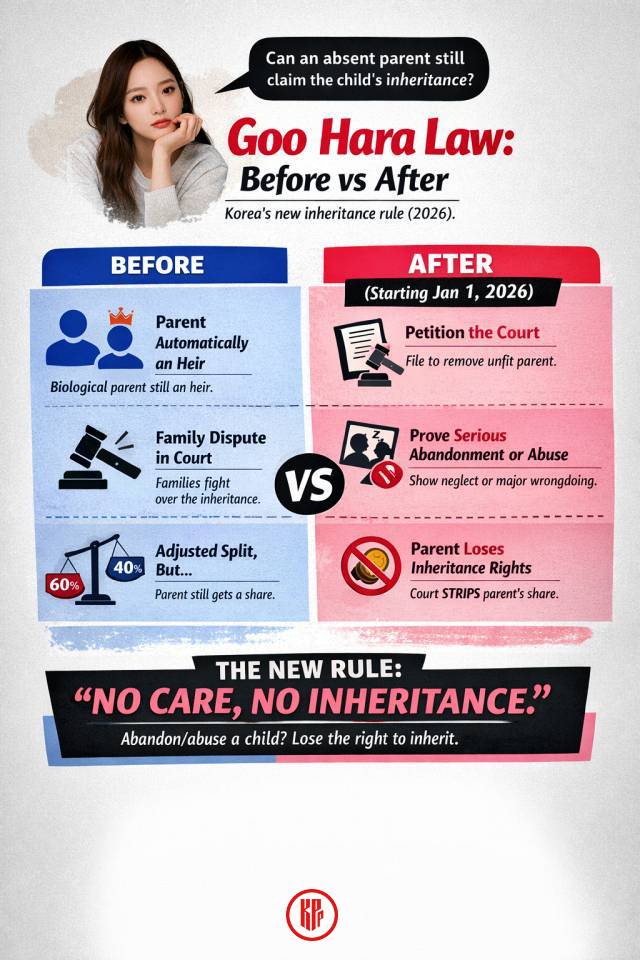
“Goo Hara Law” creates a path. But it’s not automatic. A parent doesn’t lose rights the moment someone accuses them. Instead, families must go through a legal step and make a request; then the Family Court will decide.
Step 1 — Check if There’s a Legal Trigger
The “Goo Hara Law” (Civil Code Article 1004-2) targets parents or other direct ascendants who may have:
- seriously neglected their child support duties while the child was a minor,
- committed a serious crime against the child (or the child’s spouse/children),,
- or treated the child in a grossly unfair manner.
Step 2 — Start the Process (two routes)
- Route A (during life): A person has the right not to write their parents’ names as heirs in a will.
- Route B (after death, no will): other co-heirs can file a petition to the Family Court to revoke inheritance rights.
Step 3 — File on Time and Submit Evidence
If there’s no will, co-heirs must file within six months after learning the relevant facts.
Step 4 — The Court Decides
The Family Court must review the claims and evidences, and prove “severe” neglect. Then it will decide on a case-by-case basis.
- Denied: the parent remains an heir.
- Approved: the court will revoke the person’s inheritance rights and redistribute the estate among the remaining heirs.
Final Thoughts
The “Goo Hara Law” takes effect on January 1, 2026.
Goo Hara’s name deserves remembrance. Her story matters, and her legacy goes beyond music.
Today, her name also lives on through a law that highlights parental duty and inheritance fairness. It pushes people to rethink what it truly means to be a parent.
Still, the law can’t rewrite every family’s story or solve every conflict.
But it draws a clearer line: children aren’t property. They deserve love, care, and fair treatment.
Join us on Kpoppost’s Instagram, Threads, Facebook, X, Telegram channel, WhatsApp Channel and Discord server for discussions. And follow Kpoppost’s Google News for more Korean entertainment news and updates.