

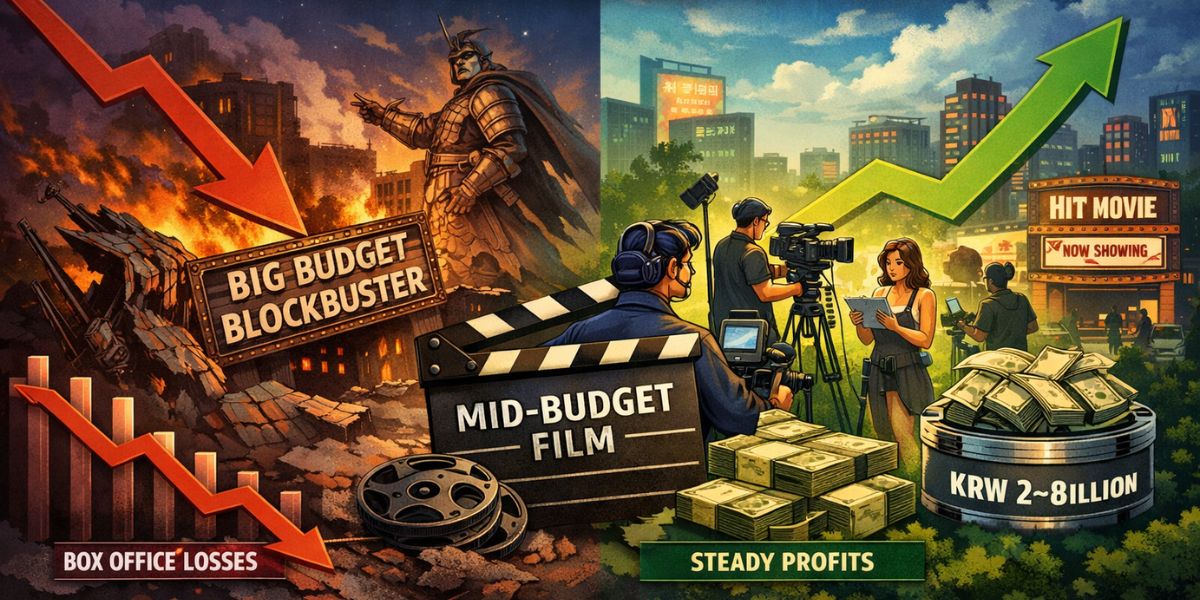
In early 2026, the South Korean film industry took an unexpected turn. While big-budget blockbusters struggled to break even at the box office, mid-budget cinema emerged as the new winners. A report by The Korea Times noted that several films with budgets of around 4-10 billion won, approximately $4-$10 million, managed to attract more than 1 million to 2.5 million moviegoers in just a few weeks of domestic release—enough to reach or even exceed the production break-even point.
Instead of relying on expensive visual effects and massive promotional campaigns, Korean filmmakers returned to their core strength: emotional storytelling. 2026 marked a crucial turning point for the K-Movie industry—a moment when profitability replaced blockbuster ambition as the new standard of success.
Mid-Budget Cinema in 2026: Profitability Over Spectacle — A Paradigm Shift
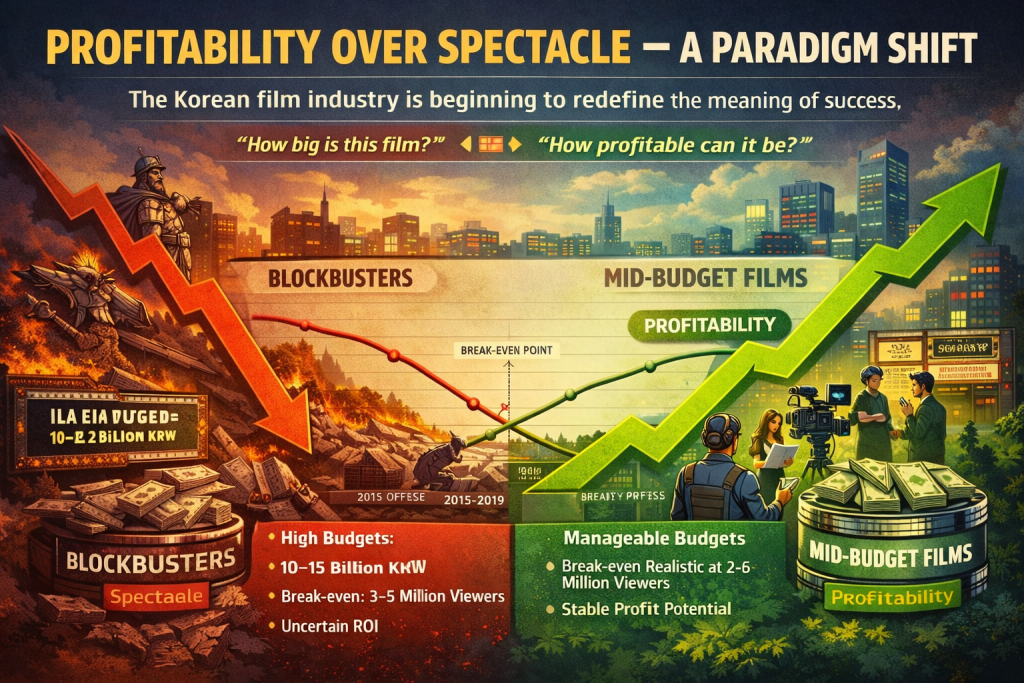
The Korean film industry is beginning to redefine the meaning of success. While previously synonymous with large-scale productions, impressive visual effects, and the ambition of box office success in the millions, profitability is now a key consideration. Investors are no longer simply asking, “How big is this film?” but rather, “How profitable can it be?”
This change is not without reason. Korea JoongAng Daily stated that in the pre-pandemic period, specifically between 2015 and 2019, Korean film budgets were relatively stable. The average blockbuster film costs around 10–15 billion KRW to produce. A strong domestic market allowed distributors to take significant risks, and break-even was typically achieved when a film attracted 3-5 million viewers.
However, post-pandemic, that foundation has begun to falter. According to ZipDo Education Reports, although blockbuster budgets remain high, at around 10-12 billion KRW, audience numbers have not fully recovered. Production costs have also ballooned: lead actors’ fees can reach 20% of the total budget, while labor costs exceed 40%. Technical standards like CGI and visual effects have become increasingly expensive, while aggressive marketing strategies aim to attract a more selective audience.
As a result, break-even can now demand more than 5 million viewers. This is where mid-budget cinema in the 2-8 billion KRW range offer a more realistic approach, where manageable costs lead to more stable profit opportunities.
The New Power Trio: Audiences, Platforms, and Industry Strategy
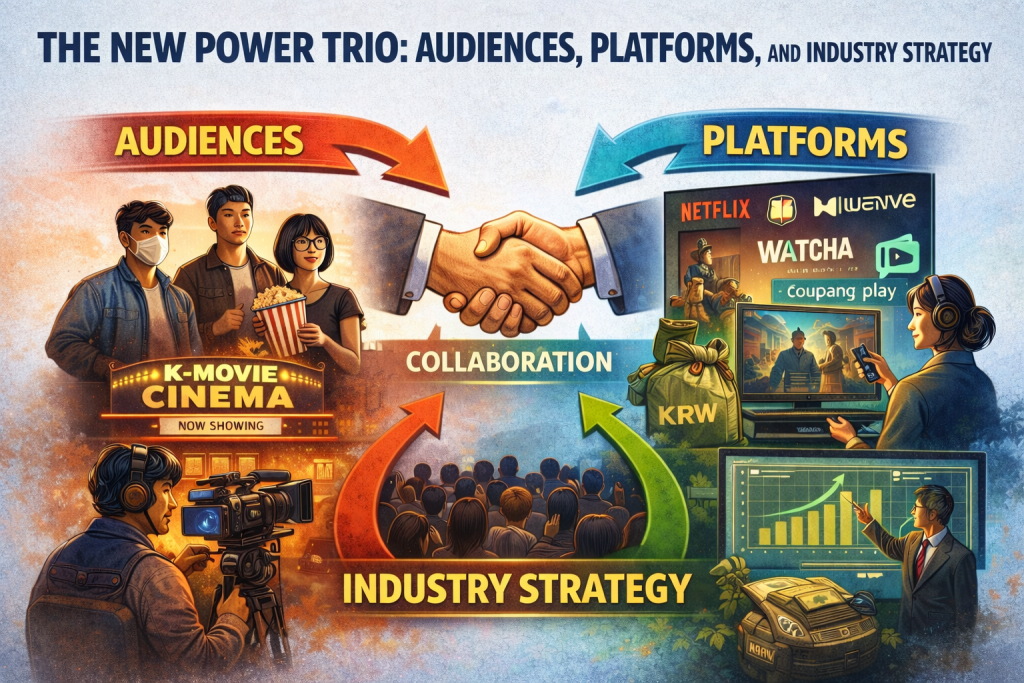
Behind the shift in industry strategy are several external factors that directly influence how films are produced, distributed, and consumed.
1. Shifting Audience Behavior
A significant shift in audience behavior is one of the main drivers of the Korean film industry’s shift toward mid-budget cinem. According to The Korea Times, audiences are now showing fatigue with the over-rehearsed blockbuster formula, preferring instead stories that offer emotional depth and strong characters. Furthermore, audiences are now seeking films with human-centered narrative depth, not just action spectacles or spectacular visual effects. Local films with simple yet powerful stories, like The Ugly, have achieved tremendous success despite their low budgets.
2. The Fragmentation of Film Distribution
Global streaming platforms like Netflix have also influenced the way consumers access films. Many viewers prefer watching at home rather than in theaters, putting pressure on traditional distribution channels and encouraging a hybrid release model—a simultaneous theatrical and digital release—to expand reach and maximize revenue.
3. Evolving Strategies of Investors and Studios
With box-office returns plummeting post-pandemic, many investors have become more conservative, prioritizing risk management by limiting exposure to major productions and shifting to more manageable projects. According to a report by Screen Daily, Korean producers are now opting for mid-sized projects that are easier to manage and have a more stable profit potential than high-budget blockbusters.
“Our target isn’t just the Korean market. We’re looking at global film and IP trends.” -Yun Ha, Director of the Policy R&D team at the Korean Film Council (Kofic).
Mid-Budget Cinema Case Study 2026
The King’s Warden — A Stable Profit Model at the Mid-Range Scale

The Korea Times reported that this film’s production budget was around 10 billion won and that it attracted more than 4.17 million viewers during the holiday season. Business-wise, this figure is crucial because in the Korean market, the average ticket costs around 10,000-12,000 won. This means the potential domestic gross could exceed 40 billion won before deducting the split with theaters and distributors.
Compared to blockbusters costing 20-25 billion won, which require more than 6-7 million viewers to break even, this film’s cost structure is much more efficient. With lower risk and a quicker ROI, the studio can secure cash flow earlier.
Once We Were Us — Cost Efficiency and Healthy Margins

The film was produced with a budget of approximately 4.5 billion won and successfully attracted over 2.5 million viewers. Roughly estimated, the potential domestic gross could be in the range of 25-30 billion won.
Because production and marketing costs were more manageable, the break-even point was reached more quickly. The profit margin was relatively higher than that of major films with massive marketing and technical costs.
Mid-budget films do have a more balanced risk-reward ratio. Break-even points are more realistic, cash flow returns are quicker, and marketing pressures are more manageable. However, blockbusters can generate substantial revenue but require a much larger audience to cover production and promotional costs.
This is why, in 2026, many Korean studios are shifting to a portfolio strategy, producing several mid-budget films with strong narratives to ensure consistent profitability, rather than relying on a single, high-cost venture.
Final Insights
Analysis of box office data and low-budget Korean film production trends in 2026 confirms that the industry is undergoing a structural shift. Based on observations and case studies, two key trends can be identified:
- Increased investment in quality mid-budget cinema — Drama, romance, and documentary genres are becoming a focus, as they have proven to attract audiences at lower costs and with healthy profit margins.
- Hybrid distribution strategy — Utilizing streaming platforms in addition to cinemas increases audience reach while maintaining cost efficiency, supporting a more sustainable business model.
The Korean film industry now prioritizes profitability and cost efficiency as key measures of success, marking a new era in which quality storytelling, coupled with a well-thought-out business strategy, is central to long-term growth.
Join us on Kpoppost’s Instagram, Threads, Facebook, X, Telegram channel, WhatsApp Channel and Discord server for discussions. And follow Kpoppost’s Google News for more Korean entertainment news and updates.