


More than 8 million viewers have watched “The King’s Warden,” a figure that immediately placed it as one of the most popular Korean films of the year. This popularity is certainly no coincidence. Besides its captivating story, there was a carefully crafted strategy, from calculated film investment decisions to marketing strategy projects designed to build hype from the initial release. Industrial Bank of Korea (IBK)’s role as an investor is worth discussing, as its approach demonstrates that the success of today’s films also lies in how effectively its business strategy is implemented, resulting in a compelling story.
The Film’s Rapid Rise in Popularity: IBK’s Film Investment Explains



According to industry officials in South Korea, as “The King’s Warden”‘s box office performance continues to improve, the spotlight is now on IBK’s content investment strategy, its financier. The film is seen as having the potential to follow in the footsteps of IBK’s previous successful investments in “Extreme Job” and “Exhuma,” which each surpassed 10 million moviegoers. IBK reportedly invested 1 billion won (approximately $699,000) in the project. If the number of moviegoers reaches 10 million, the bank is expected to set another record for profitable film investment, making everyone eager to see what strategy is behind it.
IBK: Strategic Film Investor
In the Republic of Korea, IBK, founded on August 1, 1961, has played a significant role in the country. This SME bank expanded its corporate lending base, particularly to SMEs, with a client base reaching 1.2 million companies as of December 14, 2015. Over time, IBK has emerged as a bank with a Midas touch in the film industry, having enjoyed a string of successes with its investments in domestic films.
This magic touch was evident when IBK invested in world-renowned films like Parasite, which went on to achieve commercial success and international awards. The bank has also backed blockbusters like Exhuma, cementing its reputation for identifying commercially viable projects. This success has positioned IBK as a consistent and deliberate player in the Korean film financing landscape.
According to The Korea Times, IBK itself has managed to generate high profits, considered extremely high because they exceed the break-even point. This is the result of the “creative content financing” department’s strategic approach within the bank’s investment strategy group. Their duties include reviewing scripts, consulting with external experts, and assessing the capabilities of the film’s director, cast, and crew. They also consider release time as a key indicator.
“Recognizing that the content sector is one of the industries with the highest added value, IBK decided to open a cultural content investment team in 2012, to nurture it as a future growth engine through policy support,” said an IBK official.
Therefore, based on the team’s assessment, the state-owned lending institution makes direct investments in small and medium-sized production companies to provide them with funds to cover production costs.
Investment Strategy Behind “The King’s Warden”
IBK’s decision to invest in The King’s Warden was based on measurable market analysis. Reports indicate that the film debuted at number one at the box office and surpassed 1 million viewers within its first few days. Historical drama in South Korea also has a strong track record. Films like Masquerade (2012), which drew over 12 million domestic viewers, demonstrate that large-scale historical productions have significant market appeal. This stable performance trend strengthens the project’s appeal from an IBK investment perspective, demonstrating a proven domestic audience base.
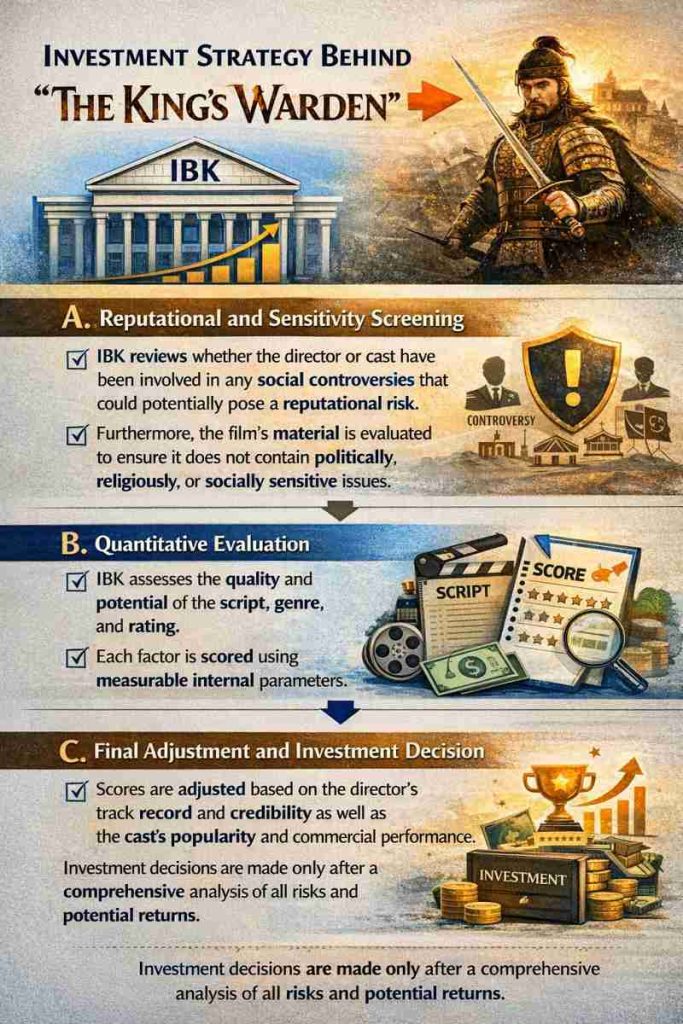
IBK implements a strict, structured project selection system across several of its films, including “The King’s Warden,”to minimize risk while safeguarding the institution’s reputation. This reflects IBK’s position as a policy bank that pursues not only financial gain but also considers public sensitivities and social interests.
1. Reputational and Sensitivity Screening
First, the IBK reviews whether the director or cast have been involved in any social controversies that could potentially pose a reputational risk. Furthermore, the film’s material is evaluated to ensure it does not contain politically, religiously, or socially sensitive issues. This is because the IBK strives to avoid projects that could trigger negative public reactions or conflict with the public interest.
2. Quantitative Evaluation
After passing the initial stage, projects enter the quantitative assessment phase, where IBK assesses the quality and potential of the script, the film’s genre, and the rating or age classification that could impact market reach. Each factor is scored based on measurable internal parameters.
3. Final Adjustment and Investment Decision
In the final stage, the score is adjusted based on the director’s track record and credibility, as well as the cast’s popularity and commercial performance. Investment decisions are made only after a comprehensive analysis of all risks and potential returns.
Can IBK’s Content Investment Model Sustain Its Success?
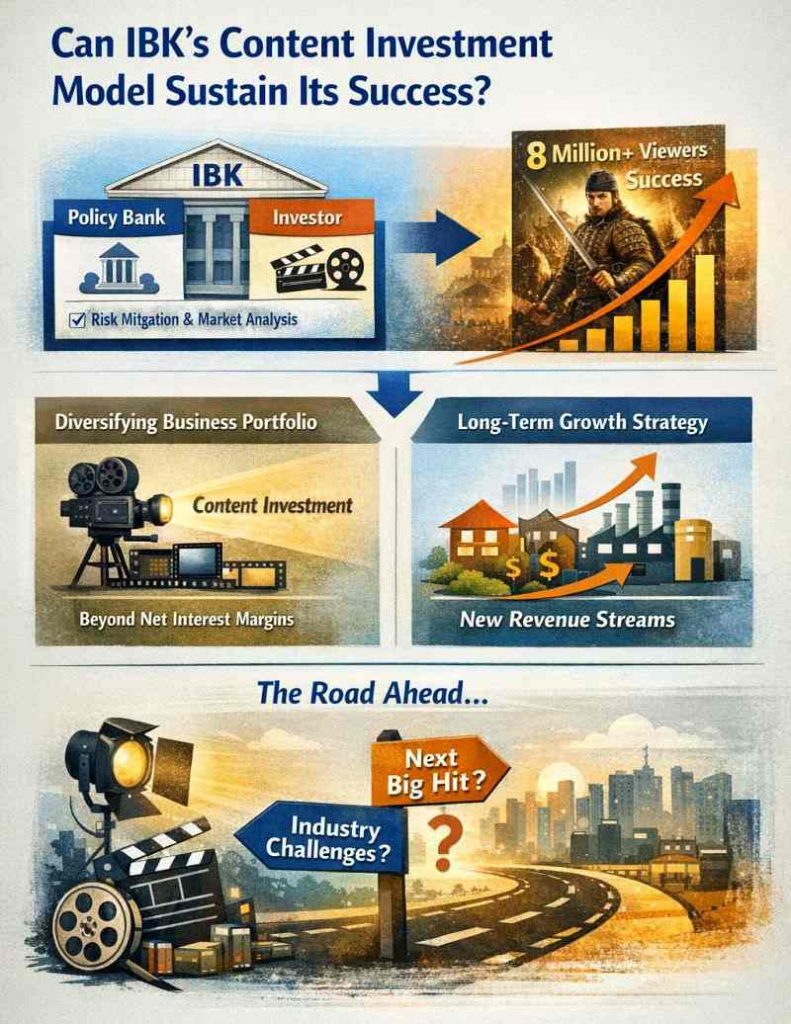
As both a policy bank and an investor, IBK has implemented project selection based on risk mitigation and measurable market analysis. The surge in viewership to over 8 million for this film demonstrates that this approach can translate into tangible commercial performance.
This project also represents a strategic move for the state-owned lending institution to diversify its business portfolio. By reducing reliance on net interest margins and seeking new growth engines, content investment is part of IBK’s long-term sustainability strategy.
Now, the question is whether IBK’s rigorous selection model can continue to produce the next hit. The industry will be closely watching how this strategy evolves amidst the increasingly competitive dynamics of the film market.
Join us on Kpoppost’s Instagram, Threads, Facebook, X, Telegram channel, WhatsApp Channel and Discord server for discussions. And follow Kpoppost’s Google News for more Korean entertainment news and updates.











挺不错的样子嘛!