

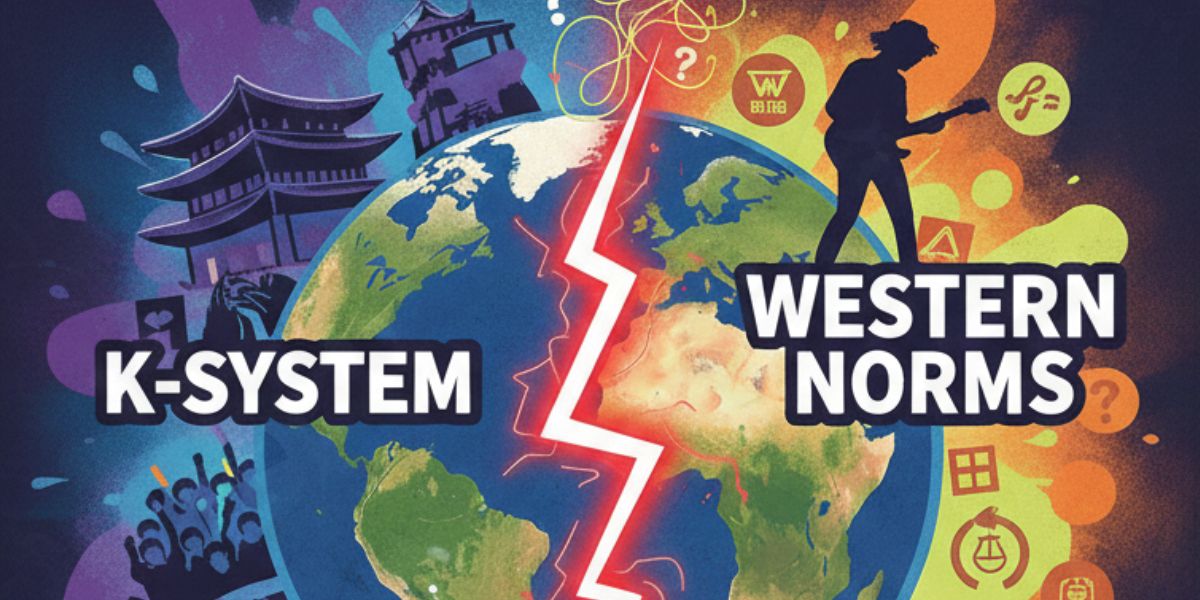
K-pop has long proven itself to be a global force. But as the industry attempts to introduce its system in Western markets, the resulting challenge goes far beyond differences in language or musical tastes. The main issue lies in the fundamental structure: while K-pop is built on rigorous trainee system, centralized management, and meticulous industrial control, the Western entertainment industry is shaped by more individualized and regulated ways of working. This contrast creates underlying friction.
When these two approaches collide, the outcome isn’t always harmonious. This is because localization isn’t just about adapting cultural elements; it’s a complex negotiation between two industry systems—each with deeply rooted values and operational methods designed specifically for them. To understand what sets the K-System apart, let’s examine how it operates at its core.
When K-System Meets Western Norms

It’s not entirely accurate to interpret the K-system as simply about music or catchy songs. This industry has a system behind it that systematically creates idols from scratch until they’re ready to perform.
In South Korea, idols aren’t just singers who emerge from nowhere. They’re the product of a highly structured training and development process.
What is K-System?
1. Strict and Years of K-pop Trainee System
The report stated that aspiring idols must undergo intensive training for years before officially debuting. During this training, they are honed in various areas, including vocals and dance, as well as foreign languages and acting.
2. Agency Designed Image
Once officially a trainee, control over their career path largely rests with their agency. From concept to image to promotional strategy, everything is designed and managed by the agency, even before the idol sets foot on their first stage.
3. Strong Agency Control
Behind K-pop’s stage, agencies nearly control every aspect of trainees’ lives, shaping even their personalities and public speaking. Trainees grow within this highly organized system before fame.
This system is one of the main reasons K-pop became a global powerhouse. But it’s also where friction begins.
When K-Pop Goes Global

To understand what K-pop has changed when it meets Western norms, it’s helpful to familiarize yourself with Choi Jung-kiu’s “Almost Everything You Need to Know About K-pop.” As reported by The Korea Times, the book is positioned as a cultural introduction that breaks down K-pop into its components, basing its analysis on concrete examples drawn from active idol groups, recent releases, and everyday industry practices.
Choi argues that it’s necessary to shift perspective, not just treating K-pop as a trend-driven genre, but also considering the system that’s formed over time, where training, production, performance, technology, and fandom are designed to move in harmony.
Major labels increasingly create global pop groups using the K-pop framework, such as KATSEYE in the US, dearALICE in the UK, and Santos Bravos in Latin America. Despite being outside Korea, these groups follow K-pop industry rules, showing the K-system’s export to Western markets.
But Western music industries operate under different expectations. And that’s where tensions emerge.
The Emerging Forms of Friction
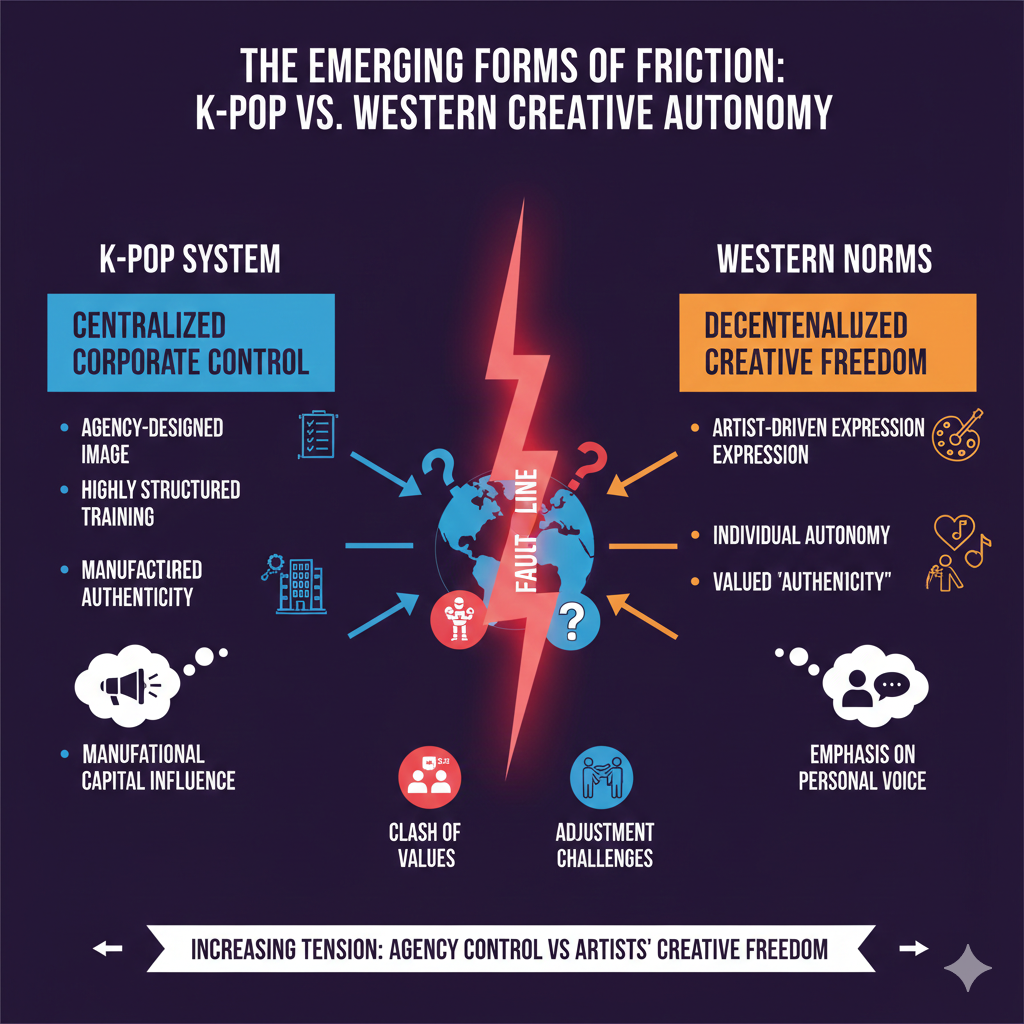
One of the most obvious frictions when the K-pop system enters the Western market is the debate between authenticity and engineered pop.
In many Western music industry contexts, “authenticity” is often understood as personal expression when the artist writes or is directly involved in the creative process. This value then becomes an important standard in assessing a musician’s credibility. However, when we bring K-pop into the equation, the industry has emerged from a highly structured system.
According to The Korea Times, as K-pop agencies globalize and adopt corporate structures increasingly influenced by international capital, this friction is expected to become more pronounced. As Korea’s centralized production system expands into Western markets, it encounters a creative culture that places greater emphasis on individual autonomy.
It also states that the tension between centralized corporate control and decentralized creative freedom will only increase. This means that the more K-pop adopts a global corporate model and operates within Western industrial environments, the greater the potential for a clash of values between agency control and artists’ creative freedom.
Value Negotiation in the Era of K-pop Globalization
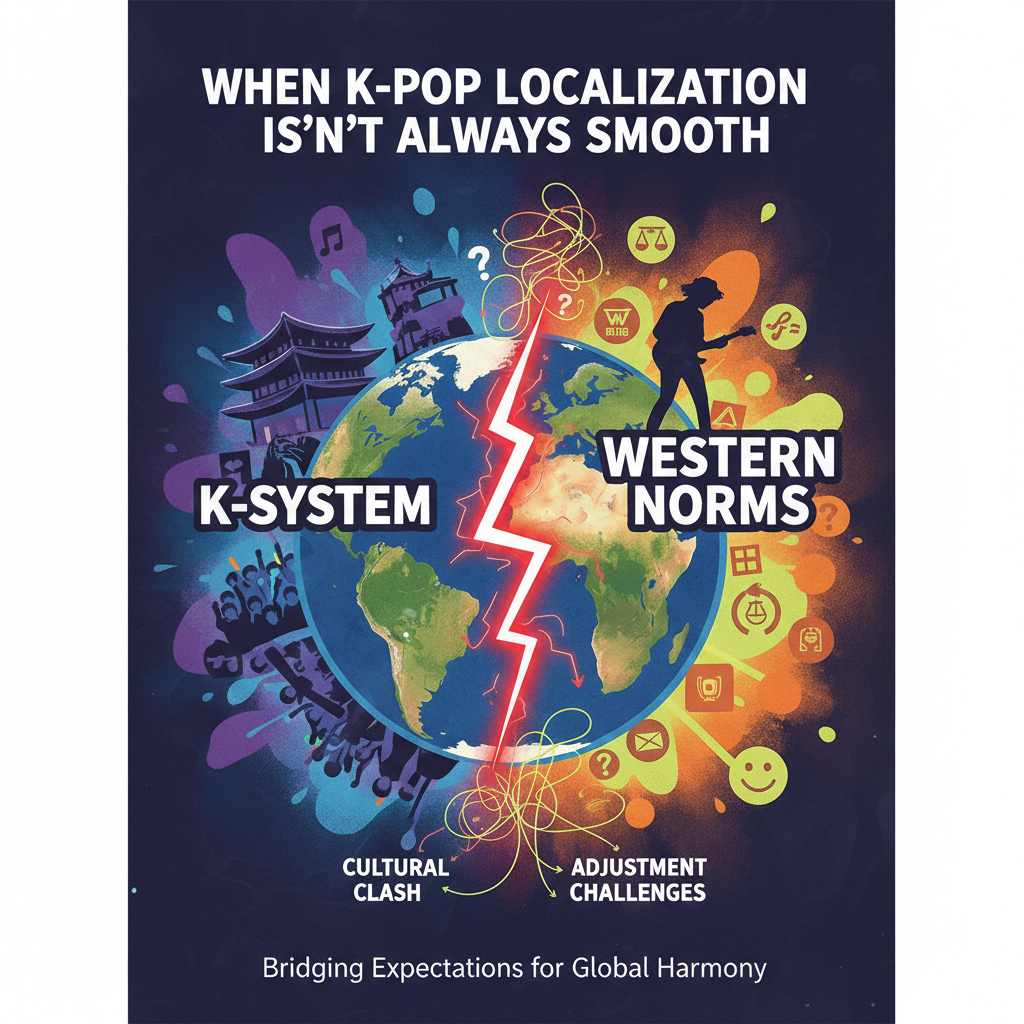
What’s occurring is more than simple market expansion. The K-System introduces its own values and structure into Western industries, and this clash with Western norms is at the heart of K-pop’s global challenges. The resulting friction between engineered pop and demands for authenticity, as well as between centralized agency control and creative autonomy, demonstrates that K-pop’s localization is a negotiation of competing industry systems more than a one-way adaptation.
But that friction is precisely what fuels change.
This ongoing clash isn’t a dead end. It’s an inflection point. The future of K-pop abroad will depend on whether it can turn its foundational logic into a source of strength—one that adapts without fracturing. That’s not just the next step for K-pop; it’s the next milestone for global pop culture integration.
Join us on Kpoppost’s Instagram, Threads, Facebook, X, Telegram channel, WhatsApp Channel and Discord server for discussions. And follow Kpoppost’s Google News for more Korean entertainment news and updates.