

The entertainment industry has become an increasingly important driver of the digital economy, particularly through the increasing economic value of Intellectual Property (IP). Music, films, and other digital content are no longer solely cultural products but also valuable financial assets. The emergence of blockchain technology is accelerating this shift by creating new opportunities for music investment and reshaping the music industry’s investment model. Platforms like Aria Protocol illustrate this transformation by enabling music tokenization. It divides song copyrights into digital tokens that investors and fans can purchase, turning creative works into tradable assets in digital marketplaces. To learn more, continue reading this article.
Challenges in the Digital Economy: Limited Liquidity and Transparency in Music Industry Investment
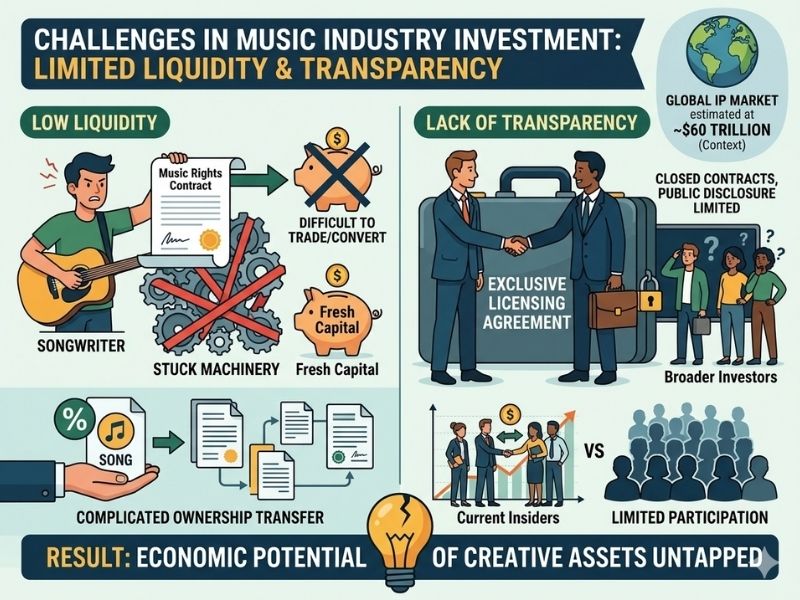
Despite the significant economic value of intellectual property, the music industry still struggles with several structural obstacles in its investment system. Experts estimate the global intellectual property market at around $60 trillion. This figure underscores the crucial role of creative assets in the digital economy.
Unfortunately, much of this market still operates inefficiently because intellectual property assets, including music rights, are difficult to trade.
One of the most striking obstacles is low liquidity. In everyday practice, music rights cannot be traded as easily as conventional financial instruments. A songwriter or copyright holder, for example, may own the rights to a work. However, the process of transferring partial ownership is often complicated and time-consuming. This makes it difficult to quickly convert these assets into fresh capital or concrete investment opportunities.
Furthermore, a lack of transparency is also a problem. Music rights holders conduct many transactions through closed contracts. They also sign exclusive licensing agreements between parties. Neither side discloses these deals to the public. As a result, opportunities for broader participation in music investment are limited. Ultimately, the industry has not fully tapped the economic potential of intellectual property. This highlights the urgent need for a more transparent and efficient system in the digital market era.
Blockchain Solutions for the Music Industry Investment

The conventional copyright market has notable limitations. It also lacks transparency. Therefore, experts propose blockchain-based music tokenization as a solution to address these issues. A startup called Aria Protocol is building a system that converts music copyrights into digital tokens stored on a blockchain network.
Simply put, tokenization is the process of converting physical assets into digital units that can be traded online. In the music industry, this concept means that the economic rights to a song can be broken down into thousands of digital token. It allows fans and investors to acquire a portion of the work.
Through this model, people view music as a financial asset within the digital economy ecosystem. For example, a song by a renowned artist could be split into multiple tokens, each representing partial ownership. Token holders receive a portion of the song’s revenue. This includes streaming royalties, licensing fees, and other related revenue sources. This model opens the door to broader music investment, transcending the boundaries of conventional industry players.
To strengthen this ecosystem, Aria Protocol has partnered with Story Protocol, a blockchain infrastructure company specializing in intellectual property management. The partnership even announced plans to tokenize approximately 140 billion won worth of Korean music assets. The assets registered on the Story blockchain include the catalogs of works by dozens of artists, including Korean trot singer Ahn Sung-hoon. Registering these assets on the blockchain infrastructure enables greater transparency and security in any music rights transactions.
What is Aria Protocol?
Aria Protocol is a blockchain-powered platform that transforms intellectual property into tradeable digital assets known as IP RWAs (Intellectual Property Real-World Assets). Rather than concentrating ownership among large corporations, Aria opens the door for everyday investors to acquire fractional stakes in income-generating IP. At the heart of the ecosystem sits the $ARIAIP token, driving governance and a range of utilities across the platform.
What is Story Protocol?
Story Protocol is a Web3 initiative tackling modern IP challenges by introducing a programmable IP layer that brings intellectual property assets on-chain. Through blockchain-powered automation, creators can embed predefined rules into their IP assets — streamlining licensing and making rights composable and extensible. Each IP Asset is tied to a dedicated IP Account built on a modified ERC-6551 standard, which transforms NFTs into dynamic smart accounts. Tying it all together, the Programmable IP License (PIL) ensures that on-chain agreements remain both legally enforceable and flexible.
How Blockchain Enables Music Investment Through the Tokenization of Music
Blockchain-based music investment systems typically operate through a series of steps that transform music rights into tradable digital assets. Through this tokenization mechanism, the platform seeks to bring together creators, investors, and fans within a single digital economic ecosystem, fostering inclusivity.
Music Rights Acquisition or Licensing
One of Korea's largest music catalogs is coming to Story.
— Story (@StoryProtocol) September 22, 2025
Notable trot singers such as Ahn Sung-hoon join Aria's iconic lineup – Justin Bieber, BTS, BLACKPINK, and more.
With $100M in tokenized Korean music from Contents Technologies, @Aria_Protocol will top $110M in IP TVL. pic.twitter.com/Ts1BFfkSiL
The first step is for the platform to acquire rights to specific works through purchase or licensing agreements with rights holders. According to Story, the catalogs compiled can include works by major artists such as BTS, BLACKPINK, Taeyang, Justin Bieber, and Miley Cyrus. In some cases, dozens of songs are included in a single catalog, providing a diverse range of assets for investors.
Music Rights Tokenization
Once the rights are acquired, each song is split into several digital tokens that are permanently recorded on the blockchain. Each token represents a fractional share of the song’s economic ownership.
Token Purchases by Investors
Investors and fans can then purchase these tokens through the available platforms. This model opens up investment opportunities in the music industry that were previously only accessible to major record labels or institutional investors. Participants purchase tokens with the expectation of receiving a portion of the revenue generated by the song.
Revenue and Return Distribution
Revenues flowing from streaming platforms, licensing agreements, and other commercial uses are distributed proportionally to all token holders. The company that developed this model projects potential annual returns of 5 to 8 percent. It makes music investments on par with other asset classes such as property, bonds, and dividend-paying stocks.
Opportunities and Challenges in Blockchain-Based Music Investment
The presence of blockchain technology in the music industry brings some exciting opportunities for the development of the digital economy. One of the most prominent advantages is its potential to increase transparency in royalty distribution. That said, blockchain records every transaction in a secure, easily traceable manner.
Furthermore, music tokenization has the potential to expand democratic access to investment. It allows the general public to participate in a market previously limited to select industry players. This model also has the potential to strengthen the relationship between creators and their fans, as audiences can now directly support and invest in the artists they love.
This system is not without its challenges. Regulations governing this space are still evolving and not fully established, while investment in digital assets in the music industry may introduce speculative risks. Furthermore, the sustainability of this model is largely determined by the extent to which blockchain technology continues to develop and is widely adopted.
Key Takeaways: The Financialization of Music in the Blockchain Era
- Blockchain technology is becoming a new form of music investment by enabling song copyrights to be converted into tradable digital tokens.
- Platforms like Aria Protocol are introducing music tokenization, enabling investors and fans to purchase partial ownership of songs and receive royalty income.
- Through a partnership with Story Protocol, the platform plans to tokenize approximately 140 billion won worth of Korean music assets, including catalogs from artists like Ahn Sung-hoon.
- This system could increase transparency in royalty distribution and expand investment in the music industry. However, challenges remain due to regulatory uncertainty and the risks associated with the emerging blockchain market.
Join us on Kpoppost’s Instagram, Threads, Facebook, X, Telegram channel, WhatsApp Channel and Discord server for discussions. And follow Kpoppost’s Google News for more Korean entertainment news and updates.