

In the algorithm-driven K-pop industry, trends can change in a matter of months. Globally, more than half of the music industry’s revenue now comes from streaming, making replay value and algorithmic performance the backbone of the business. But amidst the dominance of hyperpop, trap, and UK garage, SM Entertainment has consistently returned to house—a groove-based genre touted as enduring. As other labels race to catch viral sounds, is SM’s move purely a matter of creative taste, or is there a business rationale behind it?
The 2015 Turning Point: Differentiation Through Sound
Speaking of the house genre, it might be helpful to flashback to 2015. That year, the genre was launched by producer LDN Noise. LDN Noise began making its mark on the K-pop scene in 2014. And they became one of the new faces of the genre’s third-generation sound. After officially joining SM Entertainment in 2015, the producer duo brought a striking breath of fresh air—moving away from the classic aesthetics of SES, HOT, and Shinhwa. They bring a more experimental approach, blending UK Garage with modern hip-hop, 90s house music into their EDM-influenced style, born from their experiences working in the US and UK.
f(x)’s “4 Walls” is arguably one of the most memorable songs from that era. It marked a major shift in f(x)’s musical direction, adopting a strong house feel—an approach perfectly aligned with LDN Noise’s production style. Interestingly, the song was originally written for SHINee before being repurposed, while SHINee later released the equally impressive “View.”
“4 Walls” isn’t just a song. It’s the title of an album considered one of f(x)’s best works, with renowned producer Kenzie featuring on several of its B-sides. The album also marked a significant milestone in the group’s journey, marking f(x)’s transition to a four-member lineup. As one of the most influential groups in the K-pop industry, f(x)’s artistic legacy through this album continues to inspire generations of idols who have come after.
Consistency Across Generations
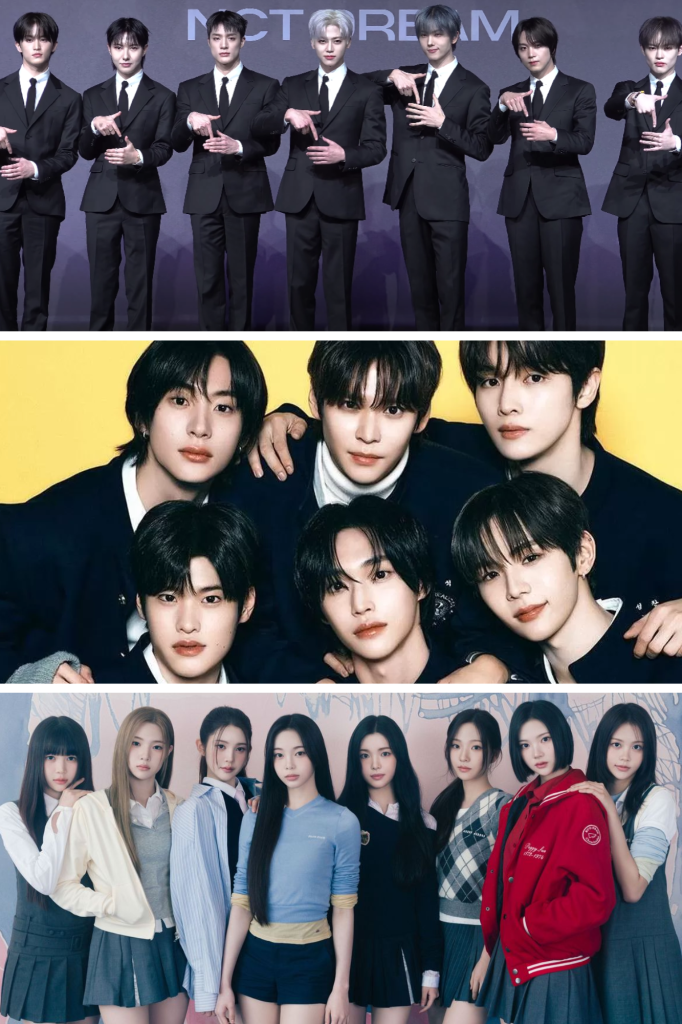
This consistency is even more visible when looking at the latest generation of SM artists, which can be seen from:
NCT Dream — We Young
NCT is one of the groups most strongly influenced by LDN Noise. SM seems to favor this genre, as the producer’s hand is found on several of NCT’s major releases, but one that’s hard to ignore is NCT Dream’s “We Young.”
At first glance, this song sounds like your average bubblegum pop. However, there’s something that sets it apart. The reggae influences LDN Noise incorporates blend seamlessly with the group’s warm, light vocals. The result is NCT Dream’s distinctive, energetic, and fun sound, one that still resonates with listeners to this day.
RIIZE — Impossible
According to The Korea Times, the house approach in “Impossible” demonstrates how SM Entertainment has adapted the genre’s foundations to suit the more performance-oriented nature of the new generation of boy groups. The song draws on elements of future house. It’s a subgenre that blends house’s signature four-beat rhythm with the more modern energy of EDM, perfect for large festival stages.
“Impossible” maintains a steady, repetitive groove. It creates the ideal space for RIIZE’s synchronized choreography and stage dynamics. Production-wise, the song feels sleek and controlled—precise layers of synths combine with a consistent bassline, both anchoring the song’s structure from beginning to end.
Hearts2Hearts — Focus
Since their debut in early 2025, Hearts2Hearts has immediately made house their primary musical identity, as evidenced by “Focus,” the lead single from their October 2025 debut mini-album. Built on a smooth, flowing deep house rhythm and enriched with uplifting piano chords, the song has been widely acclaimed as one of the most representative examples of SM Entertainment’s mature and controlled approach to house music.
House as a Global-Ready Sound
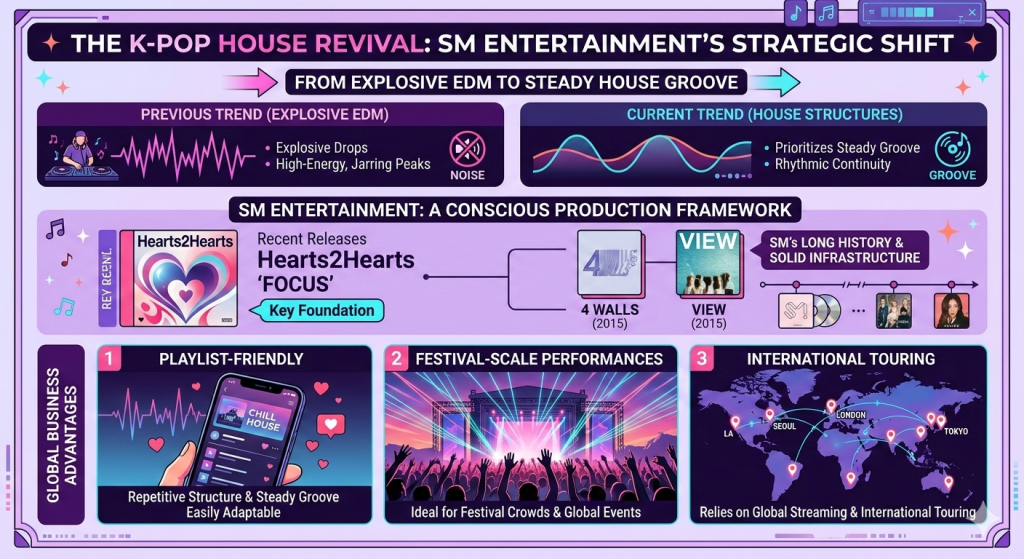
In fact, house music is once again stealing attention in the current K-pop landscape. Reports indicate that K-pop is shifting away from explosive drop-based EDM toward house structures that prioritize steady grooves and rhythmic continuity. The report also highlights several recent releases from SM Entertainment artists, including Hearts2Hearts’ “Focus” as evidence that house is now a key foundation of their musical direction. It is suggested that the house has become a consciously chosen production framework by the agency.
Looking back, this isn’t the first time SM has embraced house as a sonic identity. The success of “4 Walls” and “View” in 2015 demonstrates that SM already has a long history and a solid production infrastructure in the genre, long before similar trends emerged.
So, with the industry increasingly reliant on global streaming and international touring, the decision to return to the house makes good business sense. The repetitive structure and steady groove make house more playlist-friendly, easily adaptable, and ideal for festival-scale performances.
Stability in a Volatile Industry
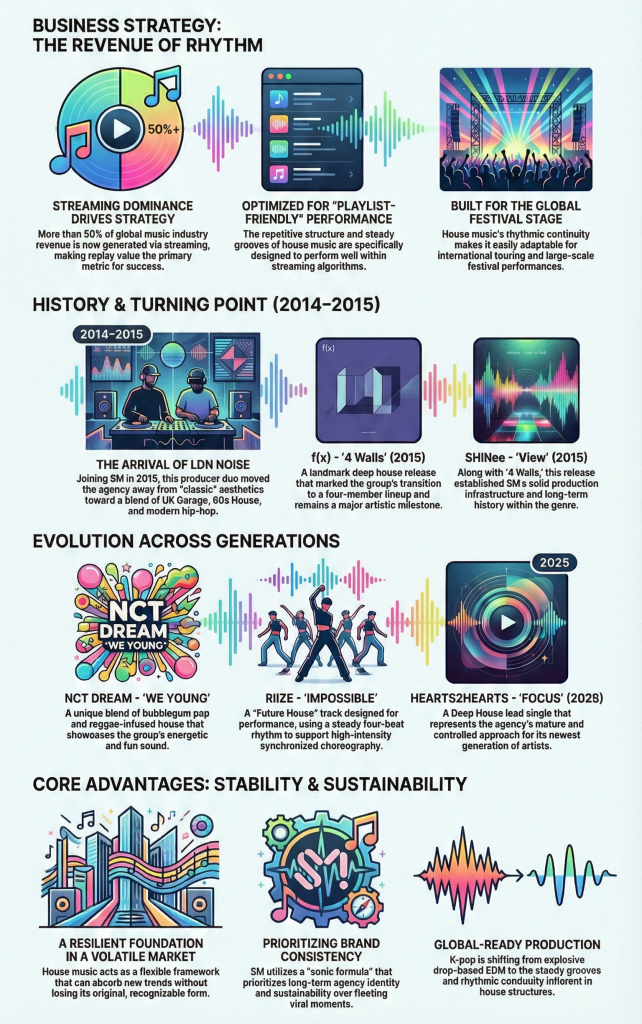
Amidst the volatile nature of the K-pop industry, house stands as a resilient foundation. This genre possesses a flexibility that few others do. It can absorb new influences from anywhere without losing its original form. SM Entertainment seems to understand this well, attempting to layer a trend over the time-tested house framework.
From a business perspective, this is a long-term calculation that prioritizes sustainability over fleeting virality. The result is a sonic formula that has a recognizable face while never losing its brand identity.
Join us on Kpoppost’s Instagram, Threads, Facebook, X, Telegram channel, WhatsApp Channel and Discord server for discussions. And follow Kpoppost’s Google News for more Korean entertainment news and updates.