

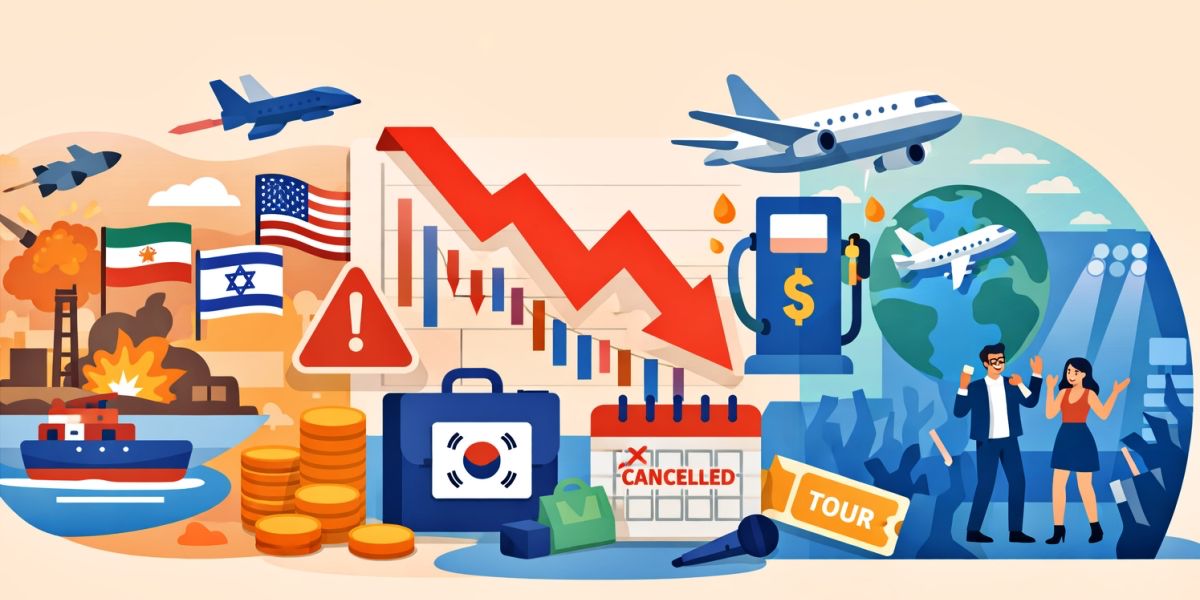
The Korean entertainment business faces new risks in 2026 amid tensions in West Asia. The conflict in West Asia has turned geopolitical risk into a direct business challenge for Korean entertainment companies that depend on global travel, stable fuel prices, and fan mobility. As tensions involving Iran, Israel, and the United States shook financial markets, the fallout quickly reached South Korea, raising concerns about K-pop tours, fan meetings, and live-event earnings.
How West Asia Tensions Are Impacting the Korean Entertainment Business in 2026
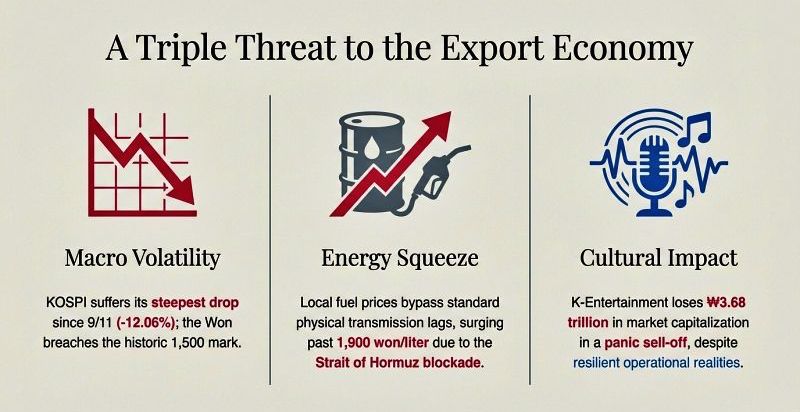


The “Big Four” agencies lost KRW 3.6 trillion in market value this March. A record 12.06% KOSPI drop triggered a “sidecar” trading suspension. BTS’s comeback and world tour proceed with caution. Meanwhile, YG Entertainment announced a massive 20th-anniversary tour for Big Bang. The South Korean government has introduced emergency fuel price controls to stabilize the domestic economy.
Why Did K-Pop Stocks Lose KRW 3 Trillion in 48 Hours?
On February 28, 2026, a conflict involving the U.S., Israel, and Iran erupted. South Korea, heavily reliant on energy imports and maritime stability, is experiencing economic shocks across sectors.
The Economic Times reported that the conflict caused South Korea’s KOSPI to plunge 12%, the largest single-day drop since 1980. It wiped out KRW 817.6 trillion (USD 553.82 billion) in Korean market capitalization over two days, while the won sharply weakened, causing investors to pull back from sectors tied to travel, events, and discretionary spending.
According to the TenAsia report, the market value of the “Big Four” agencies fell by KRW 3.6814 trillion (USD 2.5 billion) over one week, highlighting investors’ anxiety.
The specific market capitalization losses in early March 2026 for each company are precise and massive:
| Company | Market Cap Loss (₩) | Market Cap Loss (USD) | Percentage Drop |
|---|---|---|---|
| HYBE | ₩2.6038T | $1.77B | Approx. 16.2% |
| SM Entertainment | ₩448.7B | $303M | 17.0% |
| YG Entertainment | ₩213.0B | $144M | Approx. 16.0% |
| JYP Entertainment | ₩415.7B | $281M | Approx. 16.0% |
Industry experts are warning of an early market contraction. Critic Kim Heon Sik noted the entertainment industry’s sensitivity:
“The entertainment industry tends to contract much earlier than other industries. The economic downturn is likely to shrink the performance industry as well.”
Kim Heon Sik
Why Are Foreign Investors Buying K-Pop Shares During A Crisis?
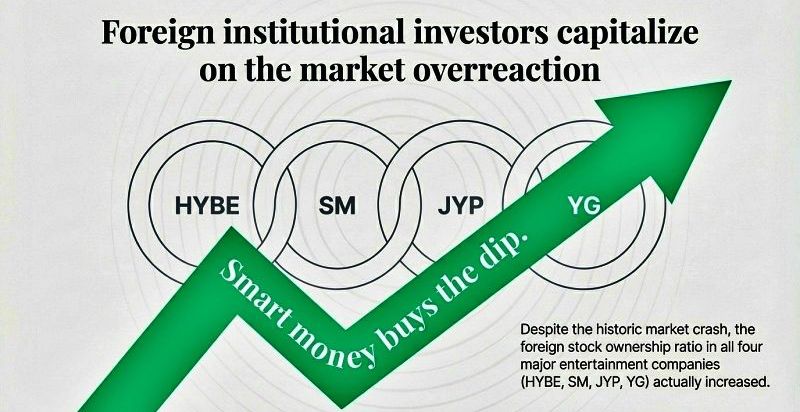
Despite recent losses, some foreign investors are viewing the market conditions as an opportunity to acquire undervalued shares. They increased their holdings across all four major companies.
This activity suggests they still believe in the industry’s resilience in the long-term K-wave economy and K-culture growth. They see K-pop as a resilient, factory-free asset. In contrast, local investors remain cautious due to ongoing uncertainties.
How Are Blocked Air Routes Stalling K-Pop World Tours?
Aviation routes are crucial for K-pop tours and fan meetings, but conflict disruptions have increased costs and complexity. Blocked flights make it significantly harder for Korean entertainment companies to organize and execute global events.
The BBC reported that, according to Flightradar24, more than 4,000 daily flight cancellations in West Asia were due to the US-Israel war on Iran in early March. This has created a massive bottleneck for travel between Asia and the West.
ATEEZ member San missed the Melbourne performance on March 2nd due to these cancellations. He returned for the March 3rd show, but the disruption remains a warning.
“…due to international flight cancellations, he will regrettably not be able to participate in the concert on that date.”
KQ Entertainment.
South Korea’s ban on travel to Iran highlights the impact of these restrictions on international travel. Geopolitical events now disrupt both logistics and artists’ ability to meet fans.
Current logistical bottlenecks include:
- Airspace closures: Safety concerns have blocked major routes over West Asia.
- Freight suspensions: High-spec air freight for stage sound and lighting is on hold.
- Fan travel: Fans face uncertainty when traveling across borders for major events.
How Does 2,000 Won Fuel Impact the Domestic K-Wave?
Domestic economic stability directly affects the entertainment market, especially when energy prices rise. Crude oil prices influence the cost of every K-pop show because tour buses, flights, and shipping containers all depend on fuel.
In South Korea, fuel prices usually change slowly. This time, however, the price jumped nearly KRW 180 per liter in just a few days, bypassing the usual lag. National averages reached KRW 1,893.3 for gasoline and KRW 1,915.37 for diesel.
Rising fuel prices can quickly feed into broader inflation because transport and logistics costs affect many sectors of the economy. As production and shipping expenses increase, companies often pass those costs on to consumers.
As fuel costs surged, the government moved to stabilize the domestic energy supply. Chosun reported that authorities recently secured 6 million barrels of crude oil from the UAE. The South Korean government is also setting price ceilings for the first time since 1997 to curb profiteering during the oil shock.
These price increases may affect entertainment activities such as cultural festivals, K-pop events, and fan meetings. Higher fuel costs can also reduce local fans’ disposable income, making it harder for them to spend on tickets and related expenses.
Inflation may affect the business in three specific ways:
- Production Costs: Local transport and stage power now cost much more.
- Shipping Rates: Moving merchandise by air or sea is more expensive.
- Consumer Sentiment: Fans have less money to spend on tickets when gas prices rise.
Will BTS Cancel the “ARIRANG” Tour Dates?
BTS members are preparing for a huge comeback to the music scene as a full group after almost 4 years. Their return, which includes an 82-show tour across 23 countries from April 2026 through 2027, is part of HYBE’s strategy to increase revenue and profits after heavy investments in 2025.
Following the crisis in West Asia, there has been no official information about the cancellation of the world tour. For now, the tour plans remain in place despite the unpredictable external business environment.
This means the more relevant question for business analysts is not just whether BTS might cancel dates, but how the volatile situation might influence other aspects of their strategy. It is whether rising fuel costs, airspace disruptions, and regional instability could narrow the margin of error for a global stadium tour.
Why Is YG Betting Big During a Global Crisis?
Amid this market chaos, YG Entertainment is celebrating its 30th anniversary this year. They are also preparing Big Bang’s world tour to celebrate the group’s 20th anniversary. Despite the turmoil, the agency is choosing growth over fear and executing new plans to keep investors calm.
Yang Hyun-suk shared his confidence in the legendary group’s return.
“We have agreed with the members of Big Bang to hold the event. We have worked together for such a long time that we don’t think there will be any difficulties.”
Yang Hyun-suk
Furthermore, YG is also releasing a full album and world tour for BabyMonster and TREASURE, and rebranding the boy group with a hip-hop concept. These moves aim to capture more domestic market share while international travel remains risky.
The High-Stakes Balancing Act
The Korean entertainment business, especially K-pop, is a global powerhouse. Yet, it remains tethered to the physical world of oil and air routes. Digital sales are strong, but tours require fuel and open skies. In a world of rising geopolitical friction, can the Korean entertainment business rely on “soft power” resilience to withstand the hard costs of war in 2026?
Join us on Kpoppost’s Instagram, Threads, Facebook, X, Telegram channel, WhatsApp Channel and Discord server for discussions. And follow Kpoppost’s Google News for more Korean entertainment news and updates.