

Korean brands are entering Southeast Asia faster than the infrastructure to support them is growing. The Hallyu wave has created genuine consumer demand across markets like Indonesia, Vietnam, and Thailand. However, converting cultural affinity into sustained commercial presence requires distribution networks, localization capability, and on-the-ground operator experience that most Korean companies do not yet have. Against this backdrop, beSUCCESS Media Group has signed a strategic partnership MOU with NestLab. NestLab is a dual-entity brand globalization platform operating across Korea and Singapore. The agreement aims to deepen cross-border ecosystem collaboration between the two organizations. Its core focus is supporting Korean brand expansion into Southeast Asia.
beSUCCESS and NestLab Formalizes Southeast Asia Brand Ecosystem Presence
beSUCCESS Media Group announced a partnership MOU with NestLab, led by founder and CEO Geunseon Song.
The agreement establishes a strategic framework for future collaboration around Korean brand globalization, Southeast Asia market access, founder ecosystem support, and cross-border brand distribution intelligence.
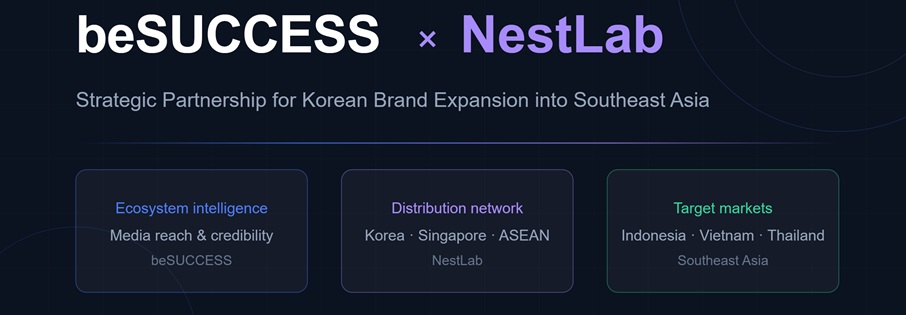
NestLab operates through a dual-entity structure. NESTLAB Inc. in Seoul handles branding, localization, and digital marketing, including content strategy, MCM, and performance marketing. Meanwhile, NESTLAB GLOBAL in Singapore serves as the regional distribution and trade hub targeting Indonesia, Vietnam, and Thailand as its primary markets.
This structure reflects a deliberate operational logic: Korean brand expertise at the creative layer, regional distribution capability at the market execution layer.
Why Southeast Asia Is Becoming a More Strategic Priority for Korea’s Startup Ecosystem
The partnership reflects a broader strategic shift happening across Korea’s outbound ecosystem.
Southeast Asia is no longer treated as a secondary expansion market. Korea’s Ministry of SMEs and Startups and KOTRA have both expanded support programs targeting ASEAN market entry over the past two years, and government-backed initiatives including programs run by KISED and Seoul FinTech Lab have increasingly included Southeast Asia as a primary expansion corridor alongside Japan and the United States.
Indonesia stands out as a particular focal point. With a population of over 270 million people and an average age of 29, the country represents one of the largest untapped consumer markets in the world for Korean brands that can navigate its local dynamics effectively.
At the same time, Korean brand entry into ASEAN markets has produced uneven results. Many companies assume that Hallyu-driven consumer interest translates automatically into market traction. It rarely does.
The Execution Gap Korean Brands Keep Running Into
NestLab CEO Geunseon Song has identified a consistent pattern in how Korean brands approach Southeast Asia, and where they fall short.
Korean marketing infrastructure is built around platforms like Naver. Southeast Asian consumers, particularly in Indonesia, operate primarily on TikTok and Instagram. The content formats, influencer dynamics, and purchase behavior are fundamentally different, and brands that apply their domestic playbook in new markets consistently underperform.
Price sensitivity is another major variable. Premium Korean brand positioning, which works in the domestic market and increasingly in Japan, often collides with affordability expectations in markets like Indonesia and Vietnam. Brands that don’t adjust their pricing architecture and product messaging to local context struggle to move beyond initial interest.
Beyond platform and pricing, trust infrastructure in Southeast Asia is relationship-driven in ways that Korean companies are not always prepared for. Song has noted that it typically takes two to three years to successfully establish a single product line in a new ASEAN market — a timeline that requires a fundamentally different approach to runway planning and partnership strategy.
NestLab’s Model Addresses a Structural Gap in Korean Brand Globalization
Geunseon Song founded NestLab on the premise that Korean brands need a system, not just a service. That system links branding, local distribution, and marketing into a single coordinated structure rather than treating each as a separate vendor relationship.
Song came to this insight through a combination of backgrounds that are uncommon in the Korean startup ecosystem: military officer, qualified startup accelerating reviewer, and operator with direct experience building cross-border distribution networks across ASEAN. This gave him a framework for analyzing market entry not from a product-first perspective, but from an ecosystem-first one.
His core philosophy: the product is only the baseline. What determines success in Southeast Asia is whether a brand can objectively analyze local context, secure credible distribution partners, and sustain the relationship-building work that market integration actually requires.
The partnership is expected to create a framework for connecting Korean brands across Southeast Asia. It will provide ecosystem intelligence and founder support resources to expansion-stage companies. Regional operator networks will also be made accessible through the collaboration. The goal is to move Korean brands from market entry to sustained market presence.
“The most meaningful opportunities in Asia’s startup ecosystem are increasingly happening at the connection points between markets, not within isolated ecosystems.”
Geunseon Song.
The logic of the beSUCCESS–NestLab partnership follows the same principle.
Why This Partnership Points to a Larger Ecosystem Trend
Korean brand globalization is evolving from a marketing problem into an infrastructure problem. Getting a Korean brand visible in Indonesia is no longer the hard part. Getting it distributed, trusted, and repurchased in a market with different platforms, different price expectations, and different relationship dynamics is where most expansion efforts stall.
This partnership combines media and ecosystem credibility. beSUCCESS brings media reach and ecosystem credibility to the partnership. Meanwhile, NestLab contributes local operator depth and distribution architecture across ASEAN. Together, they form a more complete model for supporting Korean brands. Neither organization could offer this level of coverage independently.
As Korea’s startup and brand ecosystem continues expanding its Southeast Asia engagement, the demand for execution-oriented partnerships over visibility-only programs is only likely to increase.
Key Takeaway
- beSUCCESS Media Group signed a partnership MOU with NestLab, a Korean-Singaporean brand globalization platform led by CEO Geunseon Song
- The partnership focuses on Korean brand expansion into Southeast Asia, including Indonesia, Vietnam, and Thailand
- NestLab operates a dual-entity structure — branding and content in Seoul, distribution and trade in Singapore
- Indonesia is a primary target market, with a population of over 270 million and an average age of 29
- Korean brands consistently underperform in ASEAN by applying domestic marketing platforms like Naver instead of local platforms like TikTok and Instagram
- Price sensitivity and relationship-driven trust dynamics remain two of the most underestimated challenges for Korean brand entry into Southeast Asia
- NestLab’s model requires two to three years of relationship building to sustainably establish a single product line in a new ASEAN market
- The partnership reflects a broader Korea ecosystem shift toward execution-oriented support structures over visibility-focused programs
Join us on Kpoppost’s Instagram, Threads, Facebook, X, Telegram channel, WhatsApp Channel and Discord server for discussions. And follow Kpoppost’s Google News for more Korean entertainment news and updates.